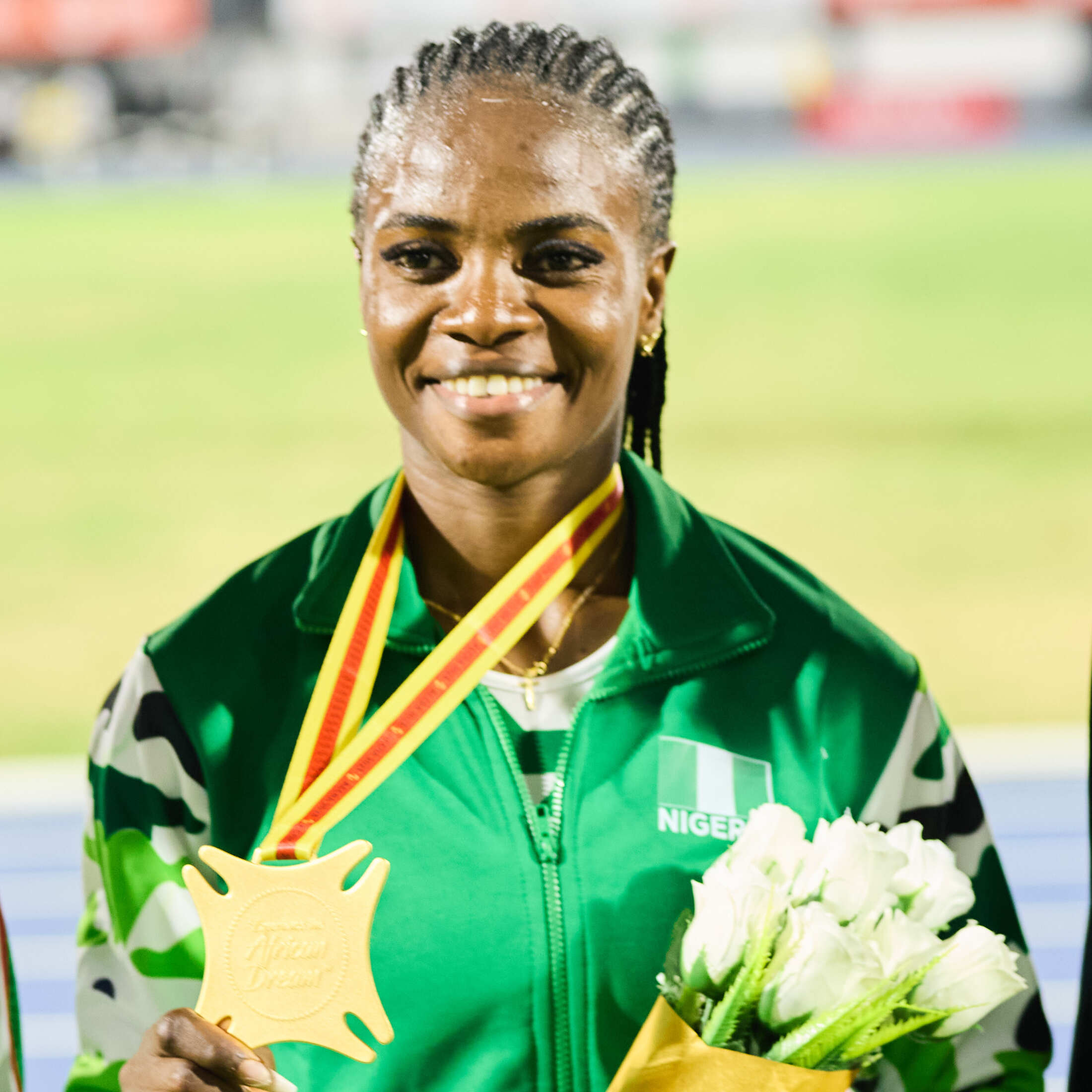
On the evening of 24 July 2022, in the brand new stadium at Hayward Field in Eugene, Oregon, a Nigerian hurdler did something that left the athletics world in disbelief. In the semi-final of the 100 metres hurdles at the World Championships, Tobi Amusan crossed the line in 12.12 seconds, a time so fast that it shattered a world record that had stood for years and seemed almost beyond reach. Less than two hours later she returned to the same track and won the final, becoming the first Nigerian athlete in history to be crowned a world champion. In the space of a single night, a woman from Ijebu-Ode had rewritten the record books and lifted an entire nation. This is the story of how she got there, and of what came after.
Quick Facts
- Full name
- Oluwatobiloba Ayomide "Tobi" Amusan
- Born
- 23 April 1997, Ijebu-Ode, Ogun State, Nigeria
- Sport
- Track and field (100 metres hurdles)
- Known for
- 2022 World Champion and world record holder
- World record
- 12.12 seconds (Eugene, 24 July 2022)
Early Life
Oluwatobiloba Ayomide Amusan was born on 23 April 1997 in Ijebu-Ode, a historic town in Ogun State in south-western Nigeria. She grew up in a household that valued education, the daughter of parents who worked as teachers, and her early ambitions were shaped as much by the classroom as by the track. Like many young Nigerians, she came to organised athletics through school competitions, where her natural speed and explosive power quickly marked her out as a talent worth nurturing.
Hurdling is among the most technically demanding events in all of track and field, a discipline that requires not only raw pace but rhythm, timing and the courage to attack a barrier at full speed without flinching or breaking stride, even when the smallest error can end a race. Amusan took to it with a dedication that impressed her early coaches, and she began to climb through the ranks of Nigerian junior athletics. The path from a school sports field in Ogun State to the summit of world athletics is a long and uncertain one, travelled by very few, but from early on she showed the blend of physical gift and fierce competitiveness that the journey demands.
Rising Through the Ranks
As her talent matured, Amusan followed a route taken by many of Africa’s most promising athletes, earning a place at an American university where she could train and compete at a high level while continuing her education. She attended the University of Texas at El Paso, known as UTEP, and competed in the fiercely contested American collegiate system. The NCAA circuit is one of the most demanding proving grounds in world athletics, and it was there that she sharpened her craft against elite competition, developing the speed and technique that would later make her a global force.
Her progress through the late 2010s was steady and serious. She began to make her mark on the senior international stage, representing Nigeria at major championships and announcing herself as a hurdler of genuine promise. She was not yet a household name, but those who followed the event closely could see a young woman improving year on year, closing the gap on the established stars of the discipline and learning how to perform when it mattered most.
The collegiate years in the United States were formative in ways that went beyond the physical. Competing week after week against the deepest field of talent in the world taught her how to race under pressure, how to manage a long and demanding season, and how to recover from defeat and come back stronger. Many African athletes have followed this same path, using the American university system as a bridge between raw promise at home and the professional ranks of world athletics, and few have made better use of it than Amusan. By the time she turned fully professional, she had absorbed the lessons of that intense environment and was ready to test herself against the very best on the global stage.
The Art of the Hurdles
To appreciate what Tobi Amusan does, it helps to understand just how unforgiving her event is. The 100 metres hurdles asks an athlete to sprint at close to top speed while clearing ten barriers, each 838 millimetres high, spaced evenly along the track. A sprinter runs in a more or less straight line; a hurdler must impose a precise rhythm on that sprint, taking exactly three strides between each barrier and attacking each one without breaking flow. A fraction of hesitation, a slightly mistimed lead leg, or a trailing foot that clips a hurdle can cost precious hundredths of a second or send an athlete crashing out of a race entirely.
The very best hurdlers make this brutal technical challenge look effortless, gliding over the barriers so smoothly that they seem barely to interrupt their running. Amusan belongs to that elite group. She combines genuine sprinting speed with an economy of movement over the barriers that wastes almost nothing, and she has the rare ability to hold her form under the most intense pressure, when a global title is at stake and the margins between glory and disappointment are measured in thousandths of a second. It is this fusion of raw pace and technical precision, honed over years of relentless practice, that made the record-breaking run possible.
Breaking Through on the World Stage
By the start of the 2020s, Tobi Amusan had established herself as a consistent finalist at the highest level, the mark of a truly world-class athlete. She collected major titles that confirmed her status as the dominant hurdler on her own continent and one of the best anywhere. She won gold at the Commonwealth Games and triumphed at the African Championships, and she became a regular contender on the lucrative Diamond League circuit, where the world’s finest track and field athletes compete across a season-long series.

What distinguished her in this period was her remarkable consistency. Reaching the final of a global championship is itself an achievement that eludes most athletes, and Amusan did it again and again, establishing herself as a fixture among the elite. She had endured the near misses that test an athlete’s resolve, the fourth-place finishes and the agonising margins that separate a medal from heartbreak. Each of those experiences hardened her, and by the time she arrived in Eugene in the summer of 2022, she was ready for something extraordinary.
Her progression through the major championships told the story of an athlete steadily closing in on the very top. She reached the final at global championships and finished agonisingly close to the podium, the kind of results that build both frustration and belief. At the delayed Tokyo Olympic Games, she made the final and finished just outside the medals, a placing that would have satisfied many but that left her hungry for more. She capped the 2021 season by winning the season-ending Diamond League final, a victory over the best in the world that signalled she was ready to convert her consistency into a major title. Everything in her career had been building toward a breakthrough, and the stage for it would be a warm evening in Oregon.
The Historic World Record
The 2022 World Athletics Championships were held in the United States, at the rebuilt Hayward Field in Eugene, Oregon, a venue regarded as a spiritual home of American track and field. In the semi-final of the 100 metres hurdles, Tobi Amusan produced the race of her life, flying over the ten barriers and stopping the clock at 12.12 seconds. The time was so fast that it broke the world record, and the stadium and the watching world reacted with a mixture of astonishment and disbelief.
“I believe in my abilities, but I was not expecting a world record at these championships. You know, the goal is always just to execute well and win the gold.”
The drama did not end there. Roughly two hours later, Amusan lined up for the final and won it convincingly, crossing the line first to become the world champion. She had run a world record and won global gold on the same evening, a feat of competitive nerve that few athletes in any event have ever matched. In doing so she became the first Nigerian athlete in history to win a World Championships title, a breakthrough of enormous significance for her country.
The world record was so far ahead of what had come before that it attracted intense scrutiny. The previous record had been lowered in tiny increments over many years, and Amusan’s time represented a leap so large that some observers initially struggled to believe it. Questions were raised about the wind gauge and the conditions on the night, since a fast but legal tailwind and the electronic timing were examined closely. The record was scrutinised carefully by the sport’s authorities before any conclusion was reached. After review, World Athletics ratified the mark, confirming Tobi Amusan as the official world record holder in the 100 metres hurdles. The doubts that had swirled around the time only made its eventual confirmation more satisfying for the athlete and her supporters, who felt she had been made to prove twice over what she had achieved once on the track.
For Nigeria, the meaning of the moment ran deep. The country had produced world-class sprinters, jumpers and footballers over the decades, and it had won Olympic and Commonwealth medals, but it had never before had a world champion in an individual track and field event at the World Athletics Championships. Amusan’s gold, and the world record that came with it, filled a gap in the nation’s sporting history and set a new benchmark for what a Nigerian athlete could achieve. Celebrations erupted at home, and she returned a national hero, her name spoken with the pride reserved for those who put their country on the map of the world.
Continued Excellence
The world title and world record transformed Amusan from a respected competitor into a national hero and a global star. Within weeks of her triumph in Eugene she added a Commonwealth Games gold in Birmingham in 2022, underlining her dominance of the event. She carried the weight of being Nigeria’s most celebrated athlete with grace, becoming a symbol of African excellence on the track.
Her career was not without difficulty. In 2023 she faced an anti-doping case relating to missed tests under the whereabouts system, the rule that requires elite athletes to declare a daily window and location where they can be found for out-of-competition testing. Three such failures within a set period can constitute a violation, even without any positive test for a banned substance, and the matter threatened to keep her out of major competition at a crucial moment. It is important to stress that the case concerned administrative missed tests rather than any finding of a prohibited substance in her system. After the matter was reviewed, she was cleared to compete, and she returned to the track determined to defend the standing she had earned.
She continued to contest finals at the highest level, including at the World Championships and the Paris 2024 Olympic Games, remaining one of the premier hurdlers in the world and an athlete capable of producing a spectacular run on any given day. The pressure of being both the world record holder and the standard-bearer for Nigerian athletics is immense, and every time she stepped onto the track she carried expectations that would weigh on any competitor. That she continued to reach finals and challenge for medals under that weight was itself a testament to her mental strength.
Beyond the Track
What has made Tobi Amusan resonate so widely, particularly among young Nigerians, is not only her success but the manner of it. She emerged from an ordinary background, without the advantages that athletes in wealthier nations often enjoy, and she reached the summit of a global sport through talent, discipline and persistence. She has spoken about the challenges facing Nigerian athletes, including the need for better support, facilities and funding, using her platform to advocate for those who will come after her.
She has carried her fame with a groundedness that has endeared her to the public. On the track she is fierce and focused; away from it she has presented herself as a relatable figure, proud of her roots in Ogun State and conscious of what her success means to the millions who follow her. For a generation of Nigerian girls, and for African athletes across many disciplines, she has become living proof that the barriers to greatness, however high they are set, can be cleared. Her influence extends beyond her medals into the realm of aspiration, showing what is achievable to those who might once have believed the summit of world sport was beyond their reach.
Career Timeline
- 23 April 1997: Born in Ijebu-Ode, Ogun State, Nigeria.
- Late 2010s: Competes collegiately for the University of Texas at El Paso (UTEP) in the American NCAA system.
- 2018: Wins the Commonwealth Games gold medal in the 100 metres hurdles in the Gold Coast, Australia.
- 2018 and beyond: Becomes a regular finalist at global championships and a fixture on the Diamond League circuit.
- 24 July 2022: Runs 12.12 seconds in the semi-final at the World Championships in Eugene, breaking the world record, then wins the final to become world champion.
- 2022: Wins Commonwealth Games gold in Birmingham, weeks after her world title.
- 2023: Faces and is cleared in an anti-doping whereabouts case, returning to competition.
- 2024: Competes at the Paris Olympic Games, remaining among the world’s elite hurdlers.
Lesser-Known Facts
- She is the first Nigerian athlete ever to win a gold medal at the World Athletics Championships, a historic first for her country.
- She ran the world record and won the world title on the same evening, within about two hours of each other, a rare feat of endurance and nerve.
- Her world record time was initially questioned over the wind reading at the stadium before being officially ratified by World Athletics.
- She competed in the American collegiate system at UTEP, a common pathway for African athletes to reach the global elite.
- Both of her parents worked as teachers, and education was a central value in the household where she grew up.
Frequently Asked Questions
What is Tobi Amusan’s world record? She set the 100 metres hurdles world record of 12.12 seconds in the semi-final at the 2022 World Championships in Eugene, Oregon, on 24 July 2022, a mark later officially ratified by World Athletics.
Where is Tobi Amusan from? She was born in Ijebu-Ode, in Ogun State, in south-western Nigeria.
Did Tobi Amusan win an Olympic medal? She has competed at the Olympic Games, including Tokyo and Paris, reaching the final, though her defining global triumph remains her 2022 World Championship gold and world record.
What happened with her doping case? In 2023 she faced an anti-doping case related to missed tests under the whereabouts system. After the case was reviewed she was cleared to continue competing.
How old is Tobi Amusan? She was born on 23 April 1997, which places her in her late twenties.
Legacy
Tobi Amusan’s achievements carry a weight that goes far beyond the record books. In a country with a deep love of sport but few global champions in track and field, she gave Nigeria its first world athletics title and one of the most astonishing performances the sport has seen. Her world record stands as a benchmark that may endure for years, and her name is now spoken alongside the greatest hurdlers in history.
For young Nigerian and African athletes, her story offers a powerful lesson: that the path from a school sports field to the summit of the world is real, and that consistency, patience and self-belief can carry an athlete from the margins of contention to the very top. She turned years of near misses into a single unforgettable night, and in doing so she showed an entire generation what was possible.
Her achievement also arrived at an important moment for Nigerian and African athletics. Across the continent, a new generation of athletes has been rising to challenge the traditional powers of the sport, and figures like Amusan serve as proof of what is achievable with the right combination of talent and determination. Her success has drawn attention to the need for investment in sporting infrastructure and support at home, so that future champions do not have to rely solely on foreign university systems and their own resilience to reach the top. In that sense her legacy is not only the record she holds but the doors she has helped to open and the conversations she has helped to start.
The girl from Ijebu-Ode did not just win a race. She rewrote what the world believed could be done, and she did it wearing the green and white of Nigeria. Whatever else her career brings, that night in Eugene secured her a permanent place in the history of her sport and in the hearts of her people, and the number beside her name, 12.12, stands as a marker of human possibility that will inspire hurdlers for years to come.