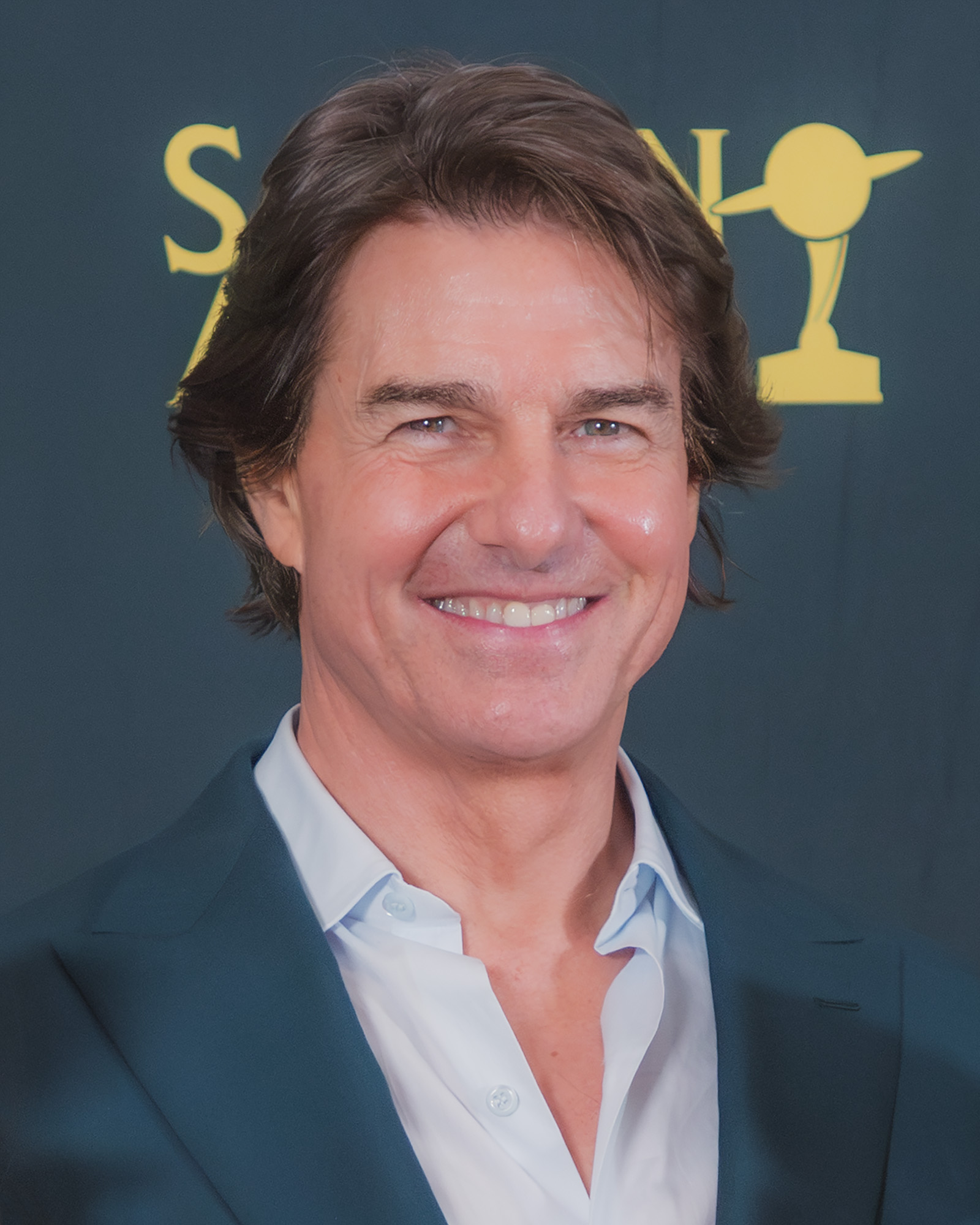
There is a particular sound that follows Tom Cruise through a film career now stretching past four decades: the collective gasp of an audience watching a man do something that no insurance company in its right mind should ever have allowed. He clings to the side of an Airbus A400M as it climbs to 1,000 feet. He free-climbs a sandstone tower in Utah with no rope. He rides a motorcycle off a Norwegian cliff and base-jumps into a ravine. While most stars of his generation long ago retreated behind green screens and stunt doubles, Cruise has spent his sixties insisting that the camera capture the real thing, that the body the audience sees falling is actually his own. He is, by common agreement, the last of a vanishing species: the genuine movie star, the name that alone can fill a theater, the man who treats going to the cinema as something close to a sacred civic duty.
Quick Facts
- Full name
- Thomas Cruise Mapother IV
- Born
- 3 July 1962, Syracuse, New York, USA
- Nationality
- American
- Known for
- Top Gun, Mission: Impossible, Jerry Maguire, Rain Man
- Career highlight
- One of the highest-grossing actors in cinema history
Early Life
Thomas Cruise Mapother IV was born on 3 July 1962 in Syracuse, New York, the third of four children and the only son of Mary Lee Pfeiffer, a special education teacher, and Thomas Cruise Mapother III, an electrical engineer. The family was of mixed German, Irish, and English descent, and Catholicism ran deep in the household. From the outside the Mapothers might have looked like a conventional mid-century American family, but the reality inside the home was far harder.
Cruise has described his father as a difficult and at times frightening figure, a man whose moods could shift without warning. In a later interview he called him “a bully and a coward,” recalling a childhood in which he learned to read the temperature of a room and to brace for sudden anger. That early vigilance, the constant reading of other people’s faces and intentions, arguably became part of the watchfulness he would later bring to the screen.
The family moved constantly. Thomas senior chased engineering work across the United States and into Canada, and young Tom changed schools again and again, attending more than a dozen by the time he reached high school. He was perpetually the new boy, forced to win acceptance from scratch in each new town, a circumstance that pushed him toward sport and physical confidence as a way of establishing himself quickly. He also struggled academically, and at the age of seven he was diagnosed with dyslexia. Reading was a daily battle. He has spoken about feeling anxious and frustrated in classrooms, about disguising the trouble he had with the printed page, and about the way the condition shaped his sense of himself as an outsider to the ordinary machinery of school.
When Cruise was around eleven, his parents separated, and his mother took the children back toward the eastern United States, raising them largely on her own in straitened circumstances. Mary Lee worked several jobs to keep the household afloat. For a period the young Cruise seriously considered the priesthood, spending roughly a year at a Franciscan seminary in Cincinnati, where he weighed a religious vocation before deciding it was not his path. He left, returned to ordinary schooling, and threw himself into wrestling, only for a knee injury to sideline him.
It was during his recovery from that injury, at a high school in Glen Ridge, New Jersey, that acting found him. He was cast in a production of the musical Guys and Dolls and discovered, almost overnight, a sense of purpose that classrooms had never given him. He made a deal with his mother and stepfather: he would take ten years to try to make it as an actor. He did not need anything close to ten. Dropping the surname Mapother, he moved to New York at eighteen, took the professional name Tom Cruise, waited tables, and chased auditions with a ferocity that would define the rest of his life.
Breakthrough
Cruise’s first real credits arrived quickly. He had a small role in Franco Zeffirelli’s Endless Love in 1981 and a more striking turn the same year in Taps, where he played a militaristic cadet with an unsettling intensity that made casting directors take notice. In 1983 he appeared in Francis Ford Coppola’s adaptation of S. E. Hinton’s The Outsiders alongside an extraordinary group of young actors that included Patrick Swayze, Matt Dillon, Rob Lowe, and Emilio Estevez.
But it was Risky Business, released in August 1983 and directed by Paul Brickman, that turned Cruise from a promising newcomer into a name to watch. As Joel Goodson, a suburban high school student whose parents leave town and whose life spirals into a chaotic entanglement with a call girl played by Rebecca De Mornay, Cruise delivered a performance of real charm and nerve. The image of him sliding across a hardwood floor in socks and a shirt, lip-syncing to a rock anthem, became instantly iconic and is still parodied today. The film was a substantial commercial success and announced that this young actor possessed something Hollywood is always hunting for: an unmistakable screen presence.
If Risky Business made Cruise interesting, Top Gun made him a global superstar. Directed by Tony Scott, produced by the powerhouse team of Don Simpson and Jerry Bruckheimer, and released in May 1986, the film cast Cruise as Lieutenant Pete “Maverick” Mitchell, a hotshot naval aviator with a reckless streak and a wounded streak to match. With its roaring fighter jets, its sun-soaked machismo, its propulsive soundtrack, and its blend of swagger and vulnerability, Top Gun became the highest-grossing film of 1986, taking in more than 350 million dollars worldwide. It also reportedly boosted United States Navy recruitment and made Cruise’s grin, his aviator sunglasses, and his cocky salute part of the visual vocabulary of the decade. At twenty-three, he was one of the most famous young men on the planet.
Proving Himself as an Actor
Stardom of that magnitude can flatten an actor into a single image. Cruise, to his lasting credit, refused to be flattened. Rather than coast on action and romance, he spent the second half of the 1980s deliberately seeking out serious filmmakers and demanding co-stars who would force him to grow.
Later in 1986 he starred in The Color of Money, Martin Scorsese’s sequel to the classic pool drama The Hustler. Cruise played a brash young pool prodigy taken under the wing of Paul Newman’s aging hustler “Fast Eddie” Felson. Newman won the Academy Award for Best Actor for the film, and working opposite a legend of that calibre gave Cruise an education in screen acting that he has cited many times since.
“I love what I do. I take great pride in what I do. And I can’t do something halfway, three-quarters, nine-tenths. If I’m going to do something, I go all the way.”
That total commitment found its fullest expression in 1988 with Rain Man, directed by Barry Levinson. Cruise played Charlie Babbitt, a self-absorbed, fast-talking car dealer who discovers he has an autistic older brother, Raymond, played by Dustin Hoffman. The role required Cruise to anchor the film, to play the less showy part with patience and restraint while Hoffman’s mannered, internal performance drew the eye. Rain Man was the highest-grossing film of 1988 and won four Academy Awards, including Best Picture and Best Actor for Hoffman. Cruise was widely praised for the generosity and discipline of his work, and the film proved he could carry a prestige drama, not just a blockbuster.
In 1989 he reunited with Oliver Stone, who had directed Platoon, for Born on the Fourth of July. Cruise played Ron Kovic, the real-life Vietnam veteran who returned home paralyzed and became an anti-war activist. It was a raw, physically and emotionally demanding role, and Cruise threw himself into it completely. The performance earned him his first Academy Award nomination for Best Actor, along with a Golden Globe win, and silenced anyone still inclined to dismiss him as merely a handsome face.
The 1990s extended his range further. In 1992 he starred in Rob Reiner’s courtroom drama A Few Good Men, sparring memorably with Jack Nicholson in the film’s famous interrogation climax. He worked with director Sydney Pollack on The Firm in 1993 and played a tormented vampire opposite Brad Pitt in Interview with the Vampire in 1994.
Then came Jerry Maguire in 1996, written and directed by Cameron Crowe. Cruise played a sports agent who experiences a crisis of conscience, walks away from his corporate empire, and tries to build something more honest with a single client and a single loyal colleague, played by Renée Zellweger. The film was a critical and commercial triumph, gave popular culture several enduring catchphrases, and earned Cruise his second Academy Award nomination for Best Actor. He capped the decade with a startling, against-type supporting performance in Paul Thomas Anderson’s Magnolia in 1999, playing a repellent self-help guru whose bravado conceals deep wounds. That role brought him a third Oscar nomination, this time for Best Supporting Actor, and remains one of the most admired performances of his career.
Mission: Impossible and the Action Era
The year 1996 marked another decisive turn. Cruise produced and starred in Mission: Impossible, a big-screen revival of the 1960s spy television series, directed by Brian De Palma. As IMF agent Ethan Hunt, Cruise headlined a slick, twisting espionage thriller built around a now-famous set piece in which he is suspended by wires inches above a pressure-sensitive floor inside a CIA vault. The film was a major hit, and it established a franchise that would become the spine of Cruise’s later career.
What set the Mission: Impossible series apart, and what gradually turned it into something close to a public spectacle, was Cruise’s escalating insistence on performing his own stunts. Across the sequels, directed by filmmakers including John Woo, J. J. Abrams, Brad Bird, and Christopher McQuarrie, the stunts grew progressively more audacious. In Mission: Impossible Ghost Protocol in 2011 he scaled the Burj Khalifa in Dubai, the tallest building in the world, clinging to the glass exterior. In Rogue Nation in 2015 he hung from the side of that Airbus A400M military transport plane as it took off, a sequence filmed for real. In Fallout in 2018 he performed a HALO jump from high altitude and broke his ankle leaping between rooftops in London, a moment visible in the finished film. For Dead Reckoning Part One in 2023 he rode a motorcycle off a mountain in Norway and parachuted to safety, a stunt he rehearsed obsessively over a year.
This dedication transformed Cruise’s public image. He became not just an actor in action films but the action itself, the man audiences paid to watch put his own body at risk. The franchise endured for nearly three decades, an extraordinary span of continuity in modern Hollywood, and it cemented his reputation as a producer who understood exactly what large audiences wanted from a night at the movies.
Stardom, Scientology and Controversy
No account of Cruise’s life can avoid the subject that has drawn the most public scrutiny: his long association with the Church of Scientology. He was introduced to the organization in the late 1980s and became, over time, one of its most prominent and outspoken members. He has credited Scientology, controversially, with helping him overcome the dyslexia that troubled his childhood, and the church has frequently held him up as a high-profile example of its teachings. Critics, former members, and journalists have raised persistent questions about the organization, and Cruise’s deep involvement has remained a recurring source of controversy throughout his career.
The most famous flashpoint came in 2005. Appearing on The Oprah Winfrey Show to discuss his new relationship with actress Katie Holmes, Cruise leapt onto the studio couch, dropped to one knee, and grabbed Oprah’s hands in a display of exuberance that struck many viewers as startling. The “couch-jumping” moment became one of the most replayed and parodied clips of the era and marked, for some, a shift in how the public perceived him. Around the same time he engaged in a heated televised exchange with the broadcaster Matt Lauer, in which he criticized the use of psychiatric medication, comments that drew sharp rebukes from medical professionals.
For a period in the mid-2000s, this intense scrutiny of his beliefs and his private life threatened to overshadow his work. Yet Cruise weathered the storm in the way he has weathered most challenges in his life: by returning, relentlessly, to the screen and to the spectacle, and by reminding audiences why they had loved watching him in the first place.
The Defender of Cinema
If any single project crystallized Cruise’s late-career mission, it was Top Gun: Maverick. A sequel arriving thirty-six years after the original, directed by Joseph Kosinski and released in May 2022, the film returned Cruise to the cockpit as an older, chastened, but still defiant Pete “Maverick” Mitchell. Cruise had insisted on filming the aerial sequences in real fighter jets, putting the young cast through a punishing flight-training program so the camera could capture genuine G-forces on their faces.
The result was a phenomenon. Top Gun: Maverick grossed close to 1.5 billion dollars worldwide, becoming the highest-grossing film of 2022 and the biggest hit of Cruise’s entire career. Crucially, it arrived just as the theatrical film industry was struggling to recover from the disruption of the COVID-19 pandemic, when many feared that audiences had permanently migrated to streaming at home. Cruise had refused to sell the film to a streaming service, holding it back for a full cinema release, and its enormous success was widely credited with helping to revive the moviegoing habit. He was praised, even by rival studio executives, as cinema’s most dependable champion, a star willing to stake everything on the proposition that the big screen still mattered.
That reputation rests on a foundation of near-fanatical commitment. Colleagues describe a man who studies every department of filmmaking, who trains for months, who insists on doing the dangerous thing himself because he believes audiences can tell the difference. In 2025 the Academy of Motion Picture Arts and Sciences awarded him an honorary Oscar in recognition of his contribution to cinema, a fitting tribute to an actor who had built his life around the conviction that movies, watched together in the dark, are worth defending.
Personal Life
Cruise’s private life has been the subject of intense public interest, particularly his three marriages, each to a fellow actress. In 1987 he married Mimi Rogers, the actress who is widely credited with first introducing him to Scientology; they divorced in 1990.
That same year he met the Australian actress Nicole Kidman while filming the racing drama Days of Thunder, and the two married in December 1990. Their high-profile partnership lasted roughly a decade and saw them act together in films including Far and Away and Stanley Kubrick’s final film, Eyes Wide Shut, released in 1999. The couple adopted two children, Isabella and Connor, before announcing their separation in 2001.
In 2006 Cruise married the actress Katie Holmes, his co-star in the public eye during the couch-jumping period. They had one child together, a daughter named Suri, born in April 2006. The marriage ended in divorce in 2012. Throughout the years that followed, Cruise’s relationships with his children, and the influence of Scientology on his family life, remained topics of intense media speculation, though he has generally kept the details intensely private.
Beyond the headlines, those who work with Cruise consistently describe a relentlessly disciplined, almost monkish professional, a man who rises early, trains hard, learns to fly helicopters and fixed-wing aircraft, and devotes himself wholly to the craft of making films. Aviation in particular has become a genuine passion rather than merely a tool of his action movies; he is a qualified pilot who owns vintage aircraft and flies them himself.
Legacy
Tom Cruise occupies a place in film history that is increasingly difficult to imagine being filled again. He emerged in an era when the movie star was the central economic engine of Hollywood, when a single name above the title could guarantee an opening weekend, and he has outlasted the very system that produced him. As studios pivoted toward franchises, intellectual property, and interchangeable casts, Cruise remained stubbornly himself: a singular brand built not on a costume or a character but on the promise of his own total commitment.
His filmography is a map of American popular cinema across more than forty years, from the youthful charm of Risky Business through the prestige dramas of Rain Man and Born on the Fourth of July, the romantic intelligence of Jerry Maguire, the darkness of Magnolia and Collateral, and the sustained physical daring of the Mission: Impossible saga. Three Academy Award nominations for acting, multiple Golden Globe wins, an honorary Oscar, and a career box office gross running into the billions of dollars all attest to the scale of his achievement.
Yet the deeper legacy may be philosophical. In an age of digital effects and home streaming, Cruise has staked his career on the old-fashioned belief that there is no substitute for the real thing seen on a giant screen, that audiences deserve genuine spectacle and genuine risk. Whether scaling a skyscraper, hanging from a plane, or flying a fighter jet inverted, he has made his own body the argument for cinema’s survival. That is why so many have called him, only half in jest, the last movie star, and why his refusal to let the form die quietly has become, in itself, one of the great Hollywood stories.
Key Facts
- Tom Cruise was born Thomas Cruise Mapother IV on 3 July 1962 in Syracuse, New York, was diagnosed with dyslexia at age seven, and briefly considered the priesthood before turning to acting.
- His breakthrough came with Risky Business in 1983, and Top Gun in 1986 made him a global superstar; he later earned three Academy Award nominations, for Born on the Fourth of July, Jerry Maguire, and Magnolia.
- He launched the Mission: Impossible franchise in 1996 and became famous for performing his own increasingly dangerous stunts, including scaling the Burj Khalifa and hanging off a flying military aircraft.
- Top Gun: Maverick in 2022 grossed close to 1.5 billion dollars and was credited with helping revive theatrical cinema after the COVID-19 pandemic.
- He was married to actresses Mimi Rogers, Nicole Kidman, and Katie Holmes, has three children, and received an honorary Academy Award in 2025 for his contribution to film.