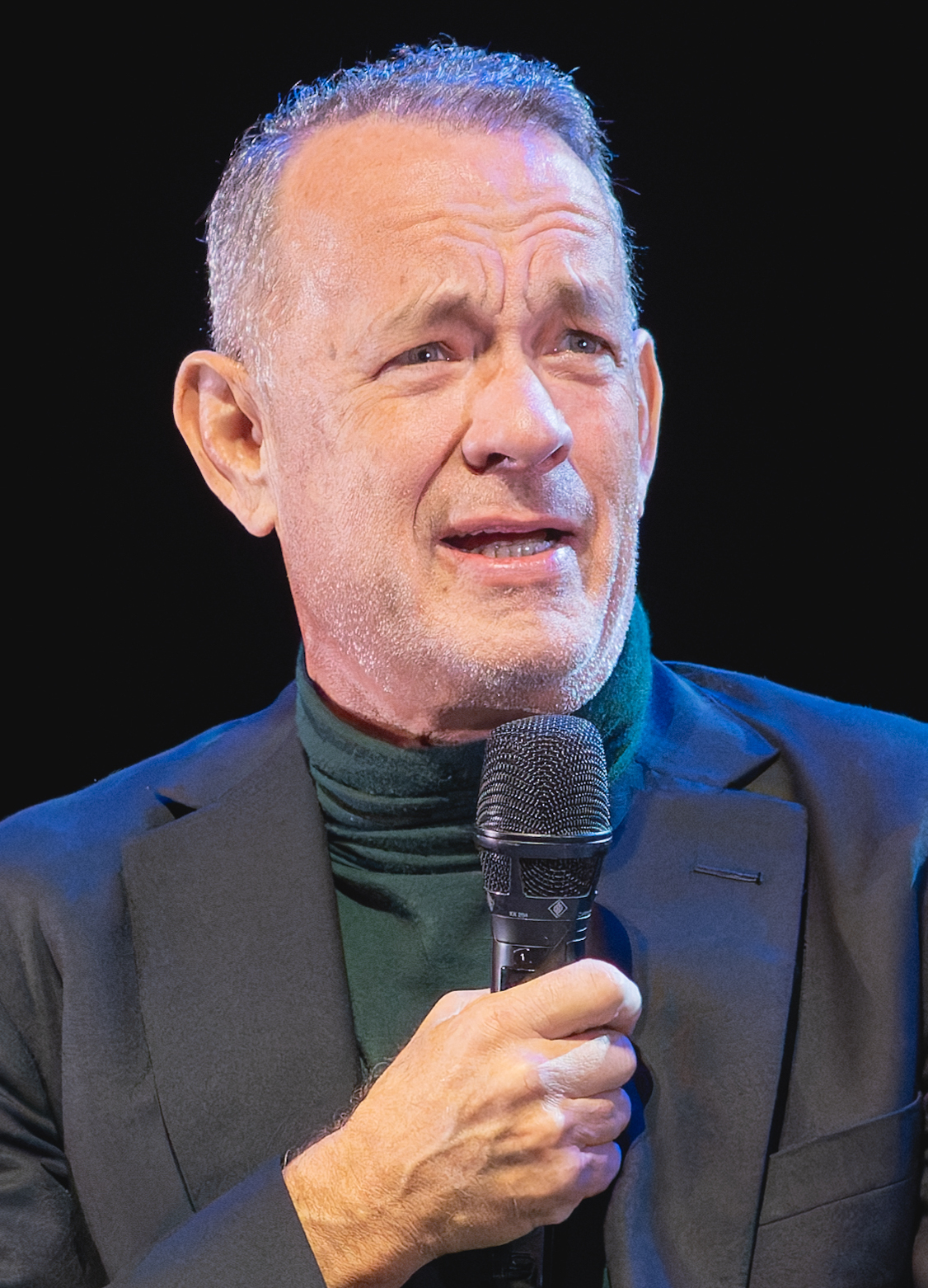
There is a peculiar kind of stardom that does not announce itself with menace or glamour. It arrives instead as a familiar face you feel you already know, a voice that seems to be speaking only to you, a presence that makes the impossible feel ordinary and the ordinary feel quietly heroic. Tom Hanks has occupied that space in American cinema for more than four decades. He has played a stranded castaway talking to a volleyball, a soldier carrying the weight of an entire generation across the beaches of Normandy, a man with a low IQ who somehow keeps stumbling into the great events of his century, and a cowboy doll voiced with so much warmth that millions of children grew up believing he was real. Across all of it, audiences kept returning to the same conclusion: this is a man you trust. That trust, more than any single performance, is the engine of one of the most remarkable careers Hollywood has ever produced.
Quick Facts
- Full name
- Thomas Jeffrey Hanks
- Born
- 9 July 1956, Concord, California, USA
- Nationality
- American
- Known for
- Forrest Gump, Saving Private Ryan, Cast Away, Toy Story
- Awards
- 2 Academy Awards for Best Actor (1994, 1995)
Early Life
Thomas Jeffrey Hanks was born on 9 July 1956 in Concord, California, a working town in the East Bay region of the San Francisco area. His father, Amos Mefford Hanks, was an itinerant cook who moved from one restaurant kitchen to another, and his mother, Janet Marylyn Frager, worked in hospitals. The marriage did not last. When Tom was five years old, his parents divorced, an event that scattered the family and set the tone for a childhood defined by constant motion.
In the settlement, Amos took the three older children, including Tom, while the youngest stayed with their mother. What followed was a restless string of relocations as his father chased work and remarried more than once. By his own account, Hanks attended a long list of schools and lived in a long list of houses, never staying anywhere quite long enough to put down roots. He has described being raised in a sprawling, blended household of step-siblings and half-siblings, a domestic landscape that kept shifting beneath him. Some children would have grown bitter or withdrawn. Hanks, by contrast, developed the adaptability of a boy who learned to read a new room quickly, to be liked fast, and to find the comedy in chaos. Those instincts would later prove to be the raw material of a movie star.
He attended Skyline High School in Oakland, where he was, by his own cheerful admission, an unremarkable student who gravitated toward the back rows and the drama department. Acting was not a grand ambition so much as a refuge, a place where the rules were clear and where his quick wit had value. He went on to Chabot College, a community college in Hayward, and later transferred to California State University, Sacramento. It was during these years that the theatre bug bit in earnest.
The decisive turn came when Hanks met Vincent Dowling, head of the Great Lakes Theater Festival in Cleveland, Ohio. Dowling invited the young Californian to come east, and Hanks spent several formative summers in Cleveland working in community and regional theatre, doing whatever the productions needed: building sets, managing props, lighting stages, and eventually acting in the classics. He has often credited this apprenticeship with teaching him the actual craft of performing, the unglamorous discipline beneath the spotlight. In 1978, his work on a production of Shakespeare’s “The Taming of the Shrew” earned him a regional acting award. He dropped out of college to commit himself fully to the stage, then made the leap that every aspiring actor eventually faces. He moved to New York City to find out whether he could make a living at it.
Television Beginnings
New York in the late 1970s was not kind to unknown actors, and Hanks scraped by on small parts and odd jobs. His first credited film role came in a low-budget 1980 slasher picture called “He Knows You’re Alone,” a forgettable entry on a resume that would soon become legendary. The real break, though, came not from film but from television.
In 1980, Hanks was cast in an ABC sitcom called “Bosom Buddies,” in which he and co-star Peter Scolari played two young advertising men in New York who, desperate for cheap housing, disguise themselves as women in order to live in an inexpensive hotel reserved for females. It was a broad premise built on a flimsy idea, but Hanks brought something to it that elevated the material: a loose, improvisational charm and an ability to make even the most contrived setups feel spontaneous. “Bosom Buddies” ran for two seasons, from 1980 to 1982, and although it never became a ratings juggernaut, it put Hanks on the radar of casting directors and producers who recognized that the tall, dark-haired comedian had a future. A guest appearance on the hit sitcom “Happy Days” reconnected him with a man who would change his life: Ron Howard, the former child actor turned director.
Howard was preparing a romantic comedy about a man who falls in love with a mermaid, and he initially considered Hanks for the supporting comic part. Instead, Hanks landed the lead. The film was “Splash,” released in 1984, co-starring Daryl Hannah as the mermaid and John Candy as the hero’s crude, lovable brother. “Splash” was a genuine surprise hit, one of the most successful comedies of its year, and it announced Hanks as a leading man with rare gifts. He could carry a romance, land a joke, and most importantly make an audience believe in the absurd. A man falling for a mermaid is a ridiculous proposition, but Hanks played it with such sincerity that audiences went along happily. The everyman quality that would define his career was already fully formed.
Comedy Years
The success of “Splash” launched Hanks into a busy stretch of mid-1980s comedies, and not all of them were good. He made a series of films that ranged from the modestly amusing to the frankly disposable: “Bachelor Party” in 1984, “The Money Pit” in 1986 alongside Shelley Long, “Volunteers” in 1985 reuniting him with John Candy, and “The Man with One Red Shoe.” Hanks himself has been candid about this period, acknowledging that he was a working actor taking the jobs that came, learning on screen, and not always choosing wisely. He was likable and bankable, but he had not yet shown Hollywood the full range of what he could do.
That changed in 1988 with “Big,” directed by Penny Marshall. Hanks played Josh Baskin, a twelve-year-old boy who makes a wish at a carnival machine and wakes up the next morning trapped in the body of a grown man. The premise could have been mere novelty, but Hanks delivered a performance of astonishing physical and emotional precision. He moved like a child, reacted like a child, and registered the bewilderment, delight, and loneliness of a boy navigating an adult world with complete conviction. The famous scene in which he and Robert Loggia dance on a giant electronic floor piano at the FAO Schwarz toy store became one of the indelible images of 1980s cinema.
“Big” was both a critical and commercial triumph, and it earned Hanks his first Academy Award nomination for Best Actor. For the first time, the industry saw him not merely as a charming comic but as an actor of real depth. He followed it with a mix of projects, including the comedies “Punchline” with Sally Field, “The ‘Burbs,” and “Turner & Hooch,” in which he was upstaged with good humor by a slobbering dog. The decade closed with Hanks established as a star, though the early 1990s would bring a few stumbles, including the notorious flop “The Bonfire of the Vanities” in 1990, before his career underwent its most dramatic transformation.
“I’ve made over 30 movies and half of them are no good. There’s only a handful that I’m really, truly proud of.”
That candid self-assessment, offered by Hanks himself, captures the unpretentious honesty that has always distinguished him. He never mistook fame for infallibility, and he was about to embark on the run of films that would justify any pride he allowed himself.
The Dramatic Turn
In 1993, Tom Hanks took the risk that redefined him. Director Jonathan Demme cast him in “Philadelphia,” a courtroom drama about Andrew Beckett, a gifted lawyer who is fired from his prestigious firm after his employers discover he has AIDS. The film, co-starring Denzel Washington as the initially reluctant attorney who takes Beckett’s discrimination case, was among the first major Hollywood productions to confront the AIDS crisis directly and to treat a gay protagonist with dignity and seriousness.
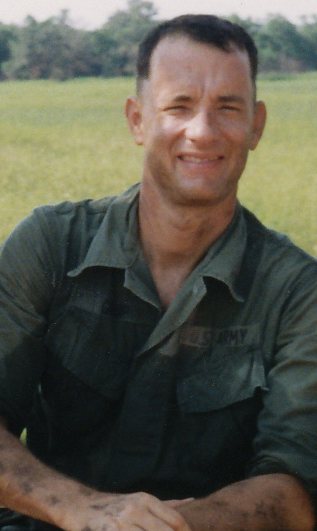
Hanks committed himself completely. He lost a significant amount of weight to portray Beckett’s physical decline, and he conveyed both the man’s professional brilliance and his quiet, dignified suffering without ever tipping into sentimentality. The performance was a revelation. For his work in “Philadelphia,” Hanks won the Academy Award for Best Actor in 1994. His acceptance speech, in which he spoke movingly about gay friends and mentors, became famous in its own right and was later said to have inspired the film “In & Out.”
Then came the role that would make him a permanent fixture of American culture. In 1994, director Robert Zemeckis released “Forrest Gump,” based on the novel by Winston Groom. Hanks played the title character, a simple, good-hearted man from Alabama with a low IQ who, through sheer innocence and persistence, finds himself present at many of the defining moments of late twentieth-century America. He becomes a college football star, a war hero in Vietnam, a champion table tennis player, a shrimp boat captain, and an unlikely millionaire, all while pining for his childhood love, Jenny, played by Robin Wright.
“Forrest Gump” was a phenomenon. It became the highest-grossing film in the United States that year, earning hundreds of millions of dollars worldwide, and it swept the Academy Awards, winning Best Picture, Best Director, and Best Adapted Screenplay among its six Oscars. Hanks won the Academy Award for Best Actor for the second consecutive year. In doing so, he achieved something that had been accomplished only once before in the history of the Academy: back-to-back Best Actor wins. The only other actor to have done so was Spencer Tracy, who won for “Captains Courageous” in 1937 and “Boys Town” in 1938. With two Oscars in two years, Hanks had vaulted into a tiny circle of the most decorated performers in cinema history.
Collaborations and Range
The latter half of the 1990s and the decades that followed revealed the breadth of Hanks’s ambitions and the depth of his collaborations. In 1995, he reunited with director Ron Howard for “Apollo 13,” the gripping true story of the ill-fated 1970 lunar mission that nearly cost three astronauts their lives. Hanks played commander Jim Lovell, anchoring an ensemble that included Kevin Bacon, Bill Paxton, and Gary Sinise. The film was both a box office success and a showcase for Hanks’s gift for portraying competent, grounded American professionals under extraordinary pressure.
The same year, 1995, brought a role that reached an entirely new audience. In Pixar’s groundbreaking “Toy Story,” the first feature-length film made entirely with computer animation, Hanks voiced Woody, the loyal cowboy doll who fears being replaced in his owner’s affections by a flashy new spaceman toy named Buzz Lightyear, voiced by Tim Allen. Hanks invested Woody with warmth, jealousy, courage, and heart, creating a character that became one of the most beloved in animation. He would return to the role across “Toy Story 2” in 1999, “Toy Story 3” in 2010, and “Toy Story 4” in 2019, a span of nearly a quarter century that allowed a generation to grow up alongside Woody.
Perhaps his most significant creative partnership was with director Steven Spielberg. In 1998, the two made “Saving Private Ryan,” a brutally realistic World War Two drama in which Hanks played Captain John Miller, leading a squad behind enemy lines to find and bring home a paratrooper whose brothers have all been killed in action. The film’s opening sequence, depicting the Allied landing at Omaha Beach on D-Day, is widely regarded as one of the most harrowing and influential battle scenes ever filmed. Hanks earned another Academy Award nomination for his restrained, deeply human portrayal of an ordinary schoolteacher transformed into a soldier. Spielberg and Hanks would collaborate repeatedly thereafter, including on the films “Catch Me If You Can” in 2002, “The Terminal” in 2004, “Bridge of Spies” in 2015, and “The Post” in 2017, as well as their celebrated television war epics.
In 2000, Hanks delivered one of his most physically demanding performances in Robert Zemeckis’s “Cast Away.” He played Chuck Noland, a FedEx executive whose plane crashes in the Pacific, stranding him alone on a deserted island for years. For long stretches the film has no dialogue and no other human characters, relying entirely on Hanks and his improvised companion, a volleyball he names Wilson. Hanks lost a substantial amount of weight and grew a wild beard to depict Chuck’s ordeal, and his performance earned yet another Oscar nomination. The relationship between a desperate man and a painted volleyball became, against all odds, one of the most emotionally affecting in modern film.
The years that followed kept Hanks busy and varied. He starred as the morally compromised hit man and father in Sam Mendes’s “Road to Perdition” in 2002, and as a con artist’s pursuer in “Catch Me If You Can.” He took on the role of Harvard symbologist Robert Langdon in the blockbuster adaptations of Dan Brown’s novels, beginning with “The Da Vinci Code” in 2006 and continuing with “Angels & Demons” in 2009 and “Inferno” in 2016. In 2013, he gave one of his most acclaimed later performances in “Captain Phillips,” directed by Paul Greengrass, playing the real-life merchant mariner whose ship was hijacked by Somali pirates. The film’s final scene, in which a traumatized Phillips is examined by a Navy medic, is frequently cited as one of the finest single moments of Hanks’s entire career.
He continued to gravitate toward real-life American figures of quiet courage. In 2016, he reunited with Clint Eastwood for “Sully,” portraying Captain Chesley Sullenberger, the pilot who landed a stricken airliner on the Hudson River and saved all aboard. And in 2019, Hanks took on a role that seemed almost predestined: Fred Rogers, the gentle host of the beloved children’s program “Mister Rogers’ Neighborhood,” in “A Beautiful Day in the Neighborhood.” His tender, understated performance as the famously kind broadcaster earned him an Academy Award nomination for Best Supporting Actor, his first acting nomination in many years and a fitting late-career tribute to an icon of decency by an actor known for the same.
As Director and Producer
Hanks’s talents were never confined to performing. In 1996, he made his directorial debut with “That Thing You Do!,” a buoyant, affectionate comedy about a one-hit-wonder pop band in the 1960s. Hanks wrote the screenplay, directed the film, and took a supporting role as the band’s manager. The movie was a modest box office performer but won lasting affection for its good humor and its evident love of its period and its music. It revealed Hanks as a filmmaker with a genuine feel for ensemble storytelling and Americana.
His most ambitious work behind the camera came in television. Partnering again with Steven Spielberg, Hanks served as a producer and creative force on the landmark HBO miniseries “Band of Brothers” in 2001, which followed Easy Company of the United States Army through the European campaign of World War Two. Painstakingly researched and produced on a then-unprecedented scale, the series was a critical triumph and won numerous Emmy Awards. Hanks and Spielberg followed it in 2010 with “The Pacific,” a companion miniseries dramatizing the brutal Pacific theatre of the same war. Together these productions helped redefine what television was capable of and cemented Hanks’s reputation as a serious steward of historical memory, particularly the legacy of the wartime generation he so admired. Through his production company, Playtone, founded with partner Gary Goetzman, Hanks went on to produce a wide range of films and series across the following decades.
Personal Life and Public Standing
Tom Hanks married actress and producer Rita Wilson in 1988, after the two met on the set of his 1985 comedy “Volunteers.” Their marriage has endured as one of the most stable and admired in Hollywood, lasting decades in an industry not known for lasting unions. Together they have two sons, Chet and Truman. Hanks also has two children, son Colin and daughter Elizabeth, from his first marriage to actress Samantha Lewes, which ended in divorce. Colin Hanks followed his father into acting. Rita Wilson has spoken publicly about surviving breast cancer, and the couple have been candid and dignified about the challenges of their shared life.
Hanks’s reputation off screen has, remarkably, matched his on-screen warmth. He is frequently described as among the most genuinely decent and approachable figures in entertainment, a man with no whiff of scandal and an apparently bottomless reserve of patience for fans and crew alike. Stories of his kindness circulate widely, from his habit of greeting wedding parties and graduates who happen to cross his path, to his easy generosity on set.
In 2013, Hanks disclosed that he had been diagnosed with type 2 diabetes, and he became an outspoken advocate for awareness of the condition, speaking frankly about how decades of unhealthy habits had contributed to it and using his platform to encourage others to take their health seriously. He has approached the subject, like most things, with humor and humility rather than self-pity.
One of his more endearing passions is a lifelong love of typewriters. Hanks owns a large collection of vintage manual machines and has spoken and written about his affection for them, even publishing a 2017 collection of short stories, “Uncommon Type,” in which a typewriter appears somewhere in every tale. He has championed an app that simulates the sound and feel of a typewriter, and his enthusiasm has helped fuel a small revival of interest in the machines. It is a fitting hobby for a man who has always seemed to belong to an older, gentler, more handmade idea of America.
Legacy
To measure Tom Hanks’s legacy purely in trophies and box office receipts is to miss the deeper point of his career, though the numbers are staggering on their own terms. He stands among a tiny handful of actors to win the Best Actor Oscar in consecutive years, alongside Spencer Tracy. His films have collectively earned billions of dollars, and several of them, including “Forrest Gump,” “Saving Private Ryan,” “Cast Away,” and the “Toy Story” series, are woven permanently into the fabric of popular culture. He has received the AFI Life Achievement Award, the Cecil B. DeMille Award, and the Presidential Medal of Freedom, among countless other honors recognizing both his artistry and his contributions to American life.
Yet his truest legacy is harder to quantify. In an industry that often rewards edge, darkness, and reinvention, Hanks built an enduring stardom on the opposite: reliability, warmth, and the portrayal of fundamental human goodness. He became, in effect, the screen embodiment of the decent American everyman, the captain who keeps his head, the father who keeps his word, the ordinary man who rises to extraordinary moments not through superpowers but through character. For audiences across generations and around the world, including in Nigeria where his films have long been staples, Tom Hanks has been a steady and trusted companion, the rare movie star whose appeal rests not on what he pretends to be but on who he genuinely seems to be.
Key Facts
- Tom Hanks won the Academy Award for Best Actor in two consecutive years, for “Philadelphia” in 1994 and “Forrest Gump” in 1995, becoming only the second actor to achieve back-to-back wins after Spencer Tracy.
- His breakthrough came on television with the ABC sitcom “Bosom Buddies” from 1980 to 1982, followed by his first film hit, “Splash,” in 1984, directed by Ron Howard.
- He has voiced the cowboy doll Woody in the “Toy Story” films since 1995, spanning four feature films across nearly twenty-five years.
- His partnership with director Steven Spielberg produced “Saving Private Ryan,” “Catch Me If You Can,” “Bridge of Spies,” and the acclaimed war miniseries “Band of Brothers” and “The Pacific.”
- A passionate collector of vintage typewriters, Hanks published a 2017 short story collection titled “Uncommon Type,” in which a typewriter features in every story.