There are sports records and then there are records that rearrange the way we understand what the human body can do. When Usain Bolt crossed the finish line in Berlin in August 2009, stopping the clock at 9.58 seconds for the 100 metres, he did not merely improve a world record. He created a kind of conceptual horizon: a number so far beyond what anyone had expected from a six-foot-five sprinter with a structural scoliosis that biomechanists are still writing papers trying to explain it. Bolt won eight Olympic gold medals, set three world records in the 100 metres and three in the 200 metres, and carried himself through it all with a joy and theatricality that made him the most loved track and field athlete in the history of the sport.
Quick Facts
- Full name
- Usain St. Leo Bolt
- Born
- 21 August 1986, Sherwood Content, Trelawny Parish, Jamaica
- Nationality
- Jamaican
- Sport
- Track and field (sprinting: 100m, 200m, 4x100m relay)
- Major titles
- 8 Olympic gold medals; 11 World Championship gold medals; World records: 9.58s (100m), 19.19s (200m)
Sherwood Content: A Country Childhood
Usain St. Leo Bolt was born on 21 August 1986, in the small rural community of Sherwood Content, in the Trelawny parish of Jamaica. The parish is known primarily for its yam farming and its cricket, and young Usain grew up playing both cricket and football long before he found athletics. His father, Wellesley Bolt, ran a small grocery shop, and his mother, Jennifer, worked in the same modest trade. The family was not wealthy, but neither were they in acute poverty. They lived in a house set amid farmland, and Usain spent his childhood outdoors, energetic and mischievous, a village boy who seemed to have more energy than he knew what to do with.
It was cricket that first captured his imagination. He was a capable fast bowler and might, in another life, have played for the West Indies. His primary school teachers remember a child who was in constant motion, who could not sit still, and who seemed to have no awareness of his own physical gifts. He was simply faster than everyone else, in the way that some children are, without understanding what that difference would mean.
His speed on the cricket pitch drew the attention of Norman Peart, who became one of his early mentors, and it was at Waldensia Primary School that a teacher first pressed a pair of running shoes into his hands and pointed him toward a track. He ran. He won. He ran again. The pattern repeated until it became a career.
William Knibb Memorial High School
The turning point in Bolt’s development came when he attended William Knibb Memorial High School in Falmouth, Trelawny, where Norman Peart introduced him to a structured training environment. The school had a tradition of producing athletic talent, and Bolt’s ability was immediately obvious to every coach who worked with him. At fifteen, in 2001, he ran 200 metres in 22.04 seconds at the Jamaican High School Championships, announcing himself as a prodigy of unusual quality.
The challenge was physical. Bolt stood well over six feet as a teenager, and his height brought with it an exaggerated stride that was simultaneously his greatest asset and a structural vulnerability. He was diagnosed with scoliosis, a sideways curvature of the spine, which placed uneven stress on his hips and hamstrings. Coaches who encountered him in these early years sometimes worried that his body would not withstand the demands of elite sprinting. A sprinter’s body, the orthodoxy held, was compact and explosive. Bolt was neither compact nor, in the conventional sense, built for the event.
What he had instead was a stride length that biomechanists would later calculate at around 2.44 metres per step at full speed, roughly the length most sprinters cover in two strides, and a stride rate that, while slightly lower than the world’s best shorter sprinters, was more than compensated for by those enormous, ground-eating bounds. He was not just fast in the way that training makes athletes fast. He was fast in the way that certain individuals simply are, a difference of kind rather than of degree.
The Junior World Champion
In 2002, at the World Junior Athletics Championships in Kingston, Jamaica, the sixteen-year-old Bolt won the 200 metres, becoming the youngest person ever to win a world junior title at that point. The margin of victory was significant enough to cause a stir, but what struck observers as much as the time was the manner of the running. Bolt appeared almost casual, running within himself and still winning by a clear distance. The Jamaican athletics community, which already knew it had someone exceptional in its ranks, began talking about him in new terms.
His coach at this stage was Norman Peart, who was later succeeded by Glen Mills, the Jamaican coach who would become the central figure in Bolt’s professional development. Mills was methodical, demanding, and deeply knowledgeable about the technical side of sprinting. He recognised that Bolt’s stride mechanics needed refinement, that his start from the blocks (always a relative weakness given his height) needed intensive work, and that his scoliosis required a sustained conditioning programme to protect him from the hamstring injuries that threatened to derail his development. The two men formed a partnership built on mutual respect and honest assessment, and it endured through Bolt’s entire professional career.
Beijing 2008: The Revelation
By 2007, Bolt had begun competing seriously at the senior international level, running 200 metres in 19.75 seconds at a meet in Athens to signal his readiness for the highest tier of competition. His coach persuaded him to add the 100 metres to his programme, a decision Bolt initially resisted, viewing himself primarily as a 200-metre runner. The 100 metres, Mills argued, would sharpen his acceleration phase and make him a more complete athlete. Bolt relented, and in May 2008, at a meet in New York, he ran 9.72 seconds to break the world record held by Asafa Powell.
The athletics world stopped. A world record in the 100 metres is not supposed to happen at a minor pre-season meet, run by someone barely warming up for an Olympic year. It is supposed to be a grand, meticulously prepared event. Bolt ran his 9.72 in sneakers that, by his own admission, were not fully laced. He had run it essentially for fun, to see what he could do. The realisation began to settle across the sport: this was not an ordinary talent.
At the Beijing Olympics in August 2008, Bolt put on the most astonishing individual performance in Olympic sprint history. In the 100 metres final on 16 August, he ran 9.69 seconds, not only setting a world record but setting it while looking to the side with twenty metres to go, slapping his chest in celebration, his shoelace undone, having visibly decelerated before the line. Physicists later estimated that a fully extended Bolt, arms driving correctly through the finish, might have run 9.55 seconds. The 200 metres final three days later produced a world record of 19.30 seconds. The 4x100 metres relay produced a third gold and a third world record of 37.10 seconds with his Jamaican teammates.
Berlin 2009: The Peak of Human Speed
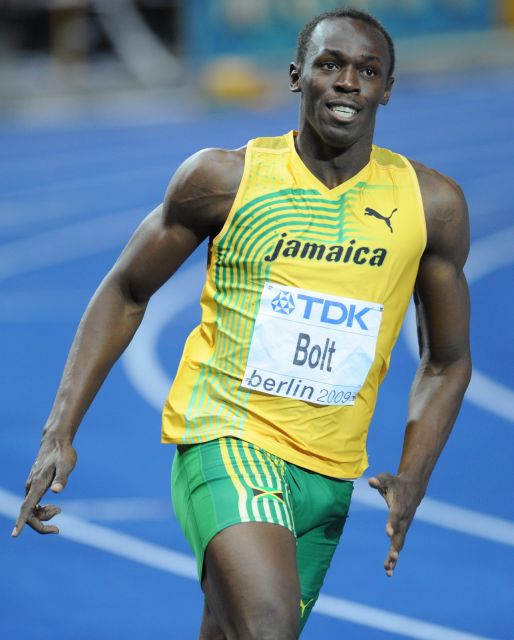
If Beijing was the announcement, Berlin was the declaration. At the 2009 World Athletics Championships in August, Bolt produced what many biomechanists regard as the greatest individual performance in the history of sprint running. In the 100 metres final, he ran 9.58 seconds, improving his own world record by 0.11 seconds, a margin described by statisticians as roughly equivalent to the improvement made across the entire previous decade of men’s 100-metre running. In the 200 metres final, he ran 19.19 seconds, another world record, and one that his biomechanics team has subsequently suggested may not be broken within the present generation of athletes.
The numbers are almost too clean to be real. They were accompanied by drug-testing under some of the most rigorous protocols in Olympic sport, carried out by the World Anti-Doping Agency in addition to the IAAF’s own testing programme. Bolt was tested more times during this period than virtually any other athlete in any sport. Every test came back clean.
“I trained four years to run nine seconds, and people give up when they don’t see results in two months.”
London 2012: Defending the Crown
The London Olympics in 2012 presented Bolt with the challenge that follows all unprecedented success: the question of whether Beijing had been a fluke of conditions and adrenalin, or a genuine representation of what he could do under any circumstances. He answered it with clarity. He won the 100 metres final in 9.63 seconds, a new Olympic record, in a race in which the first five finishers all ran under 9.80 seconds, the deepest result in the history of the event. He won the 200 metres in 19.32 seconds. He anchored Jamaica to another 4x100 metres relay gold in a world record time of 36.84 seconds.
Between major championships he continued competing on the Diamond League circuit, racing in stadiums across Europe and the United States, drawing crowds that athletes in other events could only marvel at. He was not merely a fast runner. He was entertainment, a genuine sporting celebrity in the tradition of Ali or Pelé, whose very presence at a meet guaranteed a sold-out venue and a television audience measured in hundreds of millions. The lightning bolt pose he performed after winning, arms pointing skyward in a V while he turned his face upward, became one of the most reproduced images in the history of sport.
Rio 2016: The Farewell Tour
Bolt came to the 2016 Rio Olympics with the stated intention of completing what he called the “triple-triple,” three consecutive Olympic titles in the 100 metres, 200 metres, and 4x100 metres relay. He was thirty years old and showing the physical marks of a decade at the summit of the hardest event in athletics. His preparation for Rio had been disrupted by a hamstring injury that limited his competition time in the months before the Games.
In Rio, he delivered. The 100 metres final on 14 August 2016 was not the world-record run of 2009, but it was a win, in 9.81 seconds, over Justin Gatlin, who had served a four-year doping ban and remained a deeply controversial figure in the sport. The 200 metres title followed, won in 19.78 seconds with a slight hamstring strain in the final metres. The relay gold completed the set.
The triple-triple was complete: three consecutive Olympic sprint doublings, plus relay gold all three times. No sprinter in history had managed anything comparable. When Bolt crossed the finish line in the relay final and was mobbed by his teammates and eventually by athletes from other countries who had come out simply to watch, it felt less like a race finish and more like a farewell procession.
The 2017 World Championships and Retirement
Bolt’s final competitive season ended in a manner that felt, in the moment, painfully symbolic. At the 2017 World Athletics Championships in London, he ran in the 100 metres final and finished third, behind Gatlin and Christian Coleman. Then, in his final race, the 4x100 metres relay, he pulled up midway through his anchor leg with a catastrophic hamstring injury, falling to the track while his teammates, bewildered and helpless, could only watch. He was helped to the finish line by two of them, and hobbled off on crutches.
It was a brutal way for the greatest sprint career in history to end. But Bolt received it with the same composure he had shown throughout his career, declining to frame it as tragedy, thanking the crowd warmly, and making clear in subsequent interviews that the injury had not diminished what came before it. He formally announced his retirement in 2017, aged thirty, though he made a brief and ultimately unsuccessful attempt to forge a career as a professional footballer with a Central Coast Mariners club in Australia in 2018.
The Man Behind the Speed
Beyond the world records and the gold medals, Bolt built a personality that transcended athletics. His relationship with the Jamaican public was not merely that of a national hero; it was something approaching a mutual love affair. He invested in Jamaican youth development programmes, supported hurricane relief efforts after the devastating storms that hit the Caribbean in 2017, and used his commercial profile to promote his home island to a global audience in a way that no previous Jamaican athlete had managed.
His commercial relationships with Puma lasted throughout his professional career and made him one of the highest-earning track athletes in history. His endorsements spanned drinks, technology, and consumer goods across multiple continents. His autobiography, “Faster Than Lightning,” published in 2013, became an international bestseller.
He had four children with his long-term partner Kasi Bennett: daughter Olympia Lightning Bolt, born in 2020, and twin boys Saint Leo Bolt and Thunder Bolt, born in 2021. The family lives primarily in Jamaica, and Bolt has been vocal about his intention to remain rooted in the country that made him.
What Made Him Different
The question that biomechanists and coaches have been trying to answer since 2008 is not simply how Bolt ran so fast, but how he ran so fast given a body that defied conventional sprint theory. Elite 100-metre sprinters are typically compact, between five-foot-nine and six-foot-one, with high stride rates that compensate for shorter individual strides. Bolt, at six-foot-five, took approximately 41 strides to cover 100 metres; his competitors typically took 44 to 46. His individual stride covered so much more ground that the lower frequency was not a disadvantage but, in the end, a decisive benefit.
His scoliosis, which caused his right leg to functionally operate about half an inch shorter than his left, was managed through an intensive core-strengthening programme developed by his conditioning team. It remained a structural vulnerability that required constant maintenance, and the hamstring injuries that punctuated his career from 2011 onward were in part a consequence of the asymmetrical stress it placed on his posterior chain.
His start from the blocks was, by the standards of elite 100-metre running, genuinely poor. He was routinely at or near the back of the field through the first 30 metres of a race. The fact that he still won, by margins that sometimes made the races look almost leisurely, speaks to something that statistics alone cannot fully capture: a peak velocity that no other human being has ever matched.
Bolt and the Jamaican Athletic Tradition
Understanding Usain Bolt requires understanding Jamaica’s relationship with sprint running, which long predates him and which produced the cultural and institutional infrastructure that made his career possible. Jamaica has been sending elite sprinters to the Olympic Games since 1948, when Arthur Wint won gold in the 400 metres at the London Olympics. The country’s high school championship athletics meet, commonly known as “Champs,” is one of the most competitive junior athletics events in the world, drawing crowds of tens of thousands to the National Stadium in Kingston and producing a consistent pipeline of world-class talent that has made Jamaica, per capita, the most successful sprint nation in Olympic history.
Bolt emerged from this tradition, trained within it, and eventually transcended it. The Jamaican public understood immediately what it had in him, not simply as an athlete but as a symbol. He was the embodiment of the island’s conviction that talent nurtured in small communities, on public tracks, with inadequate equipment but unlimited determination, could compete with and defeat the products of vastly better-resourced athletic programmes in the United States, Europe, and elsewhere. When he ran in Beijing, in Berlin, in London, in Rio, the Jamaican flags in the stands were not merely expressions of national pride. They were arguments about what a small island was capable of producing.
His relationship with his home country was personal and sustained. He did not simply bank his earnings abroad and return on holidays. He invested in Jamaican communities, supported youth programmes, and made his presence felt in the island’s public life in ways that kept him connected to the people who had first believed in him. His training base remained in Jamaica throughout his career, at the Racers Track Club in Kingston under Glen Mills, a choice that was as much philosophical as practical. He could have trained anywhere in the world with the resources available to him. He trained at home.
The Science of Bolt
The biomechanics community has spent more time studying Usain Bolt’s running mechanics than those of any other sprinter in history. The questions generated by his performances are genuinely fascinating and not entirely resolved. How did a man with a body type categorically mismatched to conventional sprint theory run faster than anyone had ever run? What can that mismatch tell us about the assumptions embedded in conventional sprint theory?
Researchers publishing in the Journal of Applied Physiology and the International Journal of Sports Science and Coaching have documented several unusual characteristics of Bolt’s running. His ground contact time (the period during each stride when his foot is in contact with the track) was longer than that of most elite sprinters. Conventional wisdom holds that shorter ground contact time produces faster running, because it reflects a more explosive push-off. Bolt’s longer contact time should, theoretically, have slowed him down. It did not, because it was associated with a force application that exceeded anything measured in a sprinter of conventional build.
His peak speed, measured by electronic timing equipment at the 2009 Berlin World Championships, was 12.4 metres per second, or approximately 44.7 kilometres per hour. This was achieved at around the 65 to 70 metre mark of the 100 metres, later in the race than most sprinters reach their peak, a consequence of his slow start that only his enormous top-end speed could compensate for. The compensation was more than adequate.
His scoliosis, which caused a measurable asymmetry in the forces generated by his left and right legs, was regarded by coaches before his career as a disqualifying condition for elite sprint performance. After his career, it is regarded as a mystery. How he generated world-record speed with a structural asymmetry that most sprint coaches would consider career-limiting remains a question without a definitive answer. The working hypothesis among researchers is that his extraordinary muscle architecture, combined with a core-strengthening programme that largely compensated for the asymmetry, produced a system whose individual components were sub-optimal but whose sum was unprecedented.
Legacy
When the archives of athletics are eventually closed, Bolt’s records may stand for decades. The 9.58 seconds for 100 metres and 19.19 seconds for 200 metres are not merely the fastest times ever run. They are times that the sport’s leading analysts describe as potentially generational, benchmarks that might define human limits for the foreseeable future in the way that Bob Beamon’s 1968 long jump world record defined that event for twenty-three years.
But records alone do not explain Bolt’s legacy. What he gave athletics was something the sport had been missing for decades: a performer. Track and field produces extraordinary athletes in every Olympic cycle, but it struggles chronically to produce personalities who can fill an arena the way that tennis, football, or boxing fill arenas. Bolt filled arenas. He filled them with people who had never watched a sprint in their lives and left knowing every detail of what they had witnessed. He gave the event a face, a pose, and a feeling that lingered long after the finish line.
Jamaica’s relationship with sprint running, already storied before him, was transformed by his career into something approaching a national mythology. The tiny island of three million people that produces an implausible percentage of the world’s fastest humans now has, in Bolt, the human embodiment of everything that mythology means.
“Easy is not an option.”
Key Facts
- Usain Bolt was born on 21 August 1986 in Sherwood Content, Trelawny, Jamaica, and grew up in a rural farming community with no obvious connection to elite athletics.
- He became the youngest World Junior 100m champion in 2002 at age sixteen and spent the next decade redefining the limits of human sprint speed.
- His world records of 9.58 seconds (100m) and 19.19 seconds (200m), both set at the 2009 Berlin World Championships, remain the official world records.
- He won eight Olympic gold medals across three Games (Beijing 2008, London 2012, Rio 2016), completing the unprecedented “triple-triple” of consecutive Olympic titles in the 100m, 200m, and 4x100m relay.
- He retired from competition in 2017 following a hamstring injury in his final race, the 4x100m relay at the London World Championships.