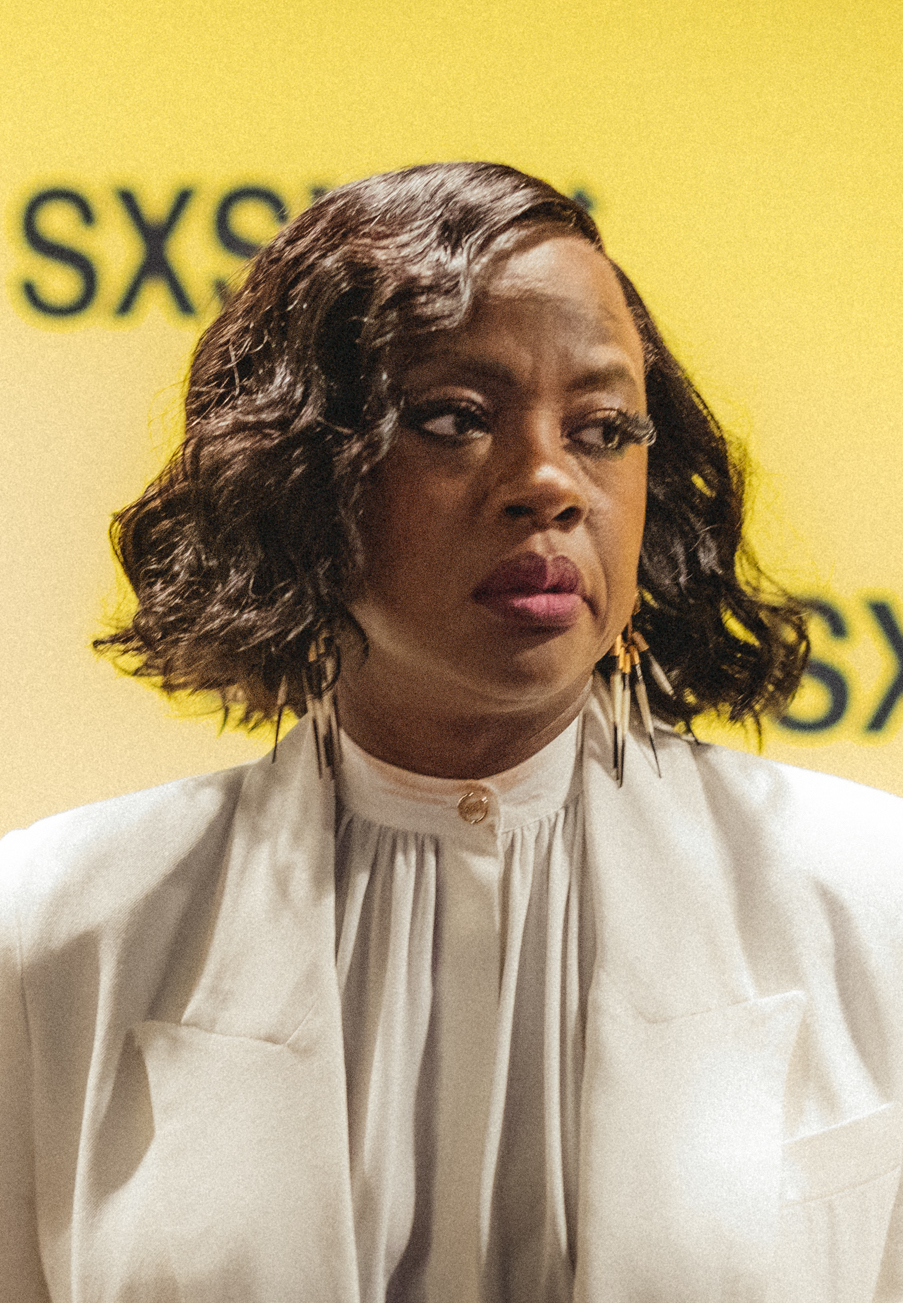
There is a scene in the 2008 film “Doubt,” directed by John Patrick Shanley, that lasts approximately eight minutes and consists almost entirely of a close-up on Viola Davis’s face. She plays a mother who has come to a Catholic school to discuss her son, and what she must communicate during those eight minutes is one of the most impossible and heartbreaking calculations a parent can face. The scene has no resolution, no comfort, no rescue. It has only a woman trying to survive what she already knows. Davis plays it without a single false note, without any of the signals that usually tell audiences they are watching acting. When the scene ends, the camera moves away, and you feel you have looked directly into the experience of being human in a way that happens very rarely, in life or in art.
Davis received an Academy Award nomination for that eight-minute performance. The nomination was for Supporting Actress, which meant her work had appeared onscreen for less than ten minutes of a film in which Meryl Streep was the lead. That she was nominated at all, and that her nomination generated serious conversation about whether she should have won, tells you something important about the specific quality she brings to whatever she is doing. She does not need time. She does not need a long arc. She needs a moment of truth, and she delivers it every single time, in a way that makes audiences forget they are watching a film.
Quick Facts
- Full name
- Viola Davis
- Born
- 11 August 1965, St. Matthews, South Carolina, USA
- Nationality
- American
- Known for
- "How to Get Away with Murder," "Fences," "The Help," "Ma Rainey's Black Bottom"
- Awards
- Academy Award (2017), Emmy Award (2015), Tony Award (2001, 2010); first Black woman to achieve the Triple Crown of Acting
St. Matthews and Central Falls: A Childhood of Scarcity
Viola Davis was born on 11 August 1965 in St. Matthews, South Carolina, the daughter of Mary Alice Davis and Dan Davis. She was the second of six children. Her father worked as a groom at a thoroughbred horse farm, a job that paid wages that were barely sufficient for a family of two and wholly insufficient for a family of eight. Her mother was a factory worker and a domestic worker. The family moved to Central Falls, Rhode Island, when Davis was very young, seeking opportunities that the rural South could not provide.
Central Falls was, and remains, one of the poorest municipalities in the United States. The house the Davis family inhabited was by any objective measure uninhabitable: it had no heat in winter, the plumbing was unreliable, there were rats, and the kind of basic physical security that most people take as a minimum floor of civilised life was simply absent. Davis has spoken about this childhood with an unflinching directness that has sometimes shocked audiences accustomed to celebrity memoirs that soften difficult origins into inspirational narratives. She was hungry regularly. She was cold. She wore clothing that she was ashamed of. She experienced the specific, corrosive shame of poverty that goes beyond discomfort to the fundamental experience of being treated as less than fully human by a society organised around money.
Her father drank, and the household was marked by the specific kind of instability that alcoholism creates: not constant violence necessarily, but the constant possibility of it, the constant recalibration of mood and behaviour required to navigate an environment where the emotional temperature can change without warning. Davis has described these experiences not to diminish her father, for whom she has expressed understanding, but because she believes that the art she makes requires the truth of where she came from, and that sanitising her origins would be a form of cowardice in someone who has built a career on the refusal of comfortable lies.
The hunger was real and sometimes literal. She has described searching for food in neighbours’ garbage cans. She has described the anxiety of school lunch programmes and what it felt like to depend on institutional charity for basic nutrition. She has described these things in awards acceptance speeches, on television talk shows, in print interviews, consistently and without apology, because she understands that her experience was not unusual among Black Americans of her generation, that millions of people share the details of what she went through, and that the refusal to speak about it is a form of the erasure she has spent her career fighting.
What saved her, she has consistently said, was the public library. In a household without books and without the money to buy them, the library was the one place where abundance was available for free. She was a voracious reader from the time she learned to read, and the world that books opened, a world where the life of the mind was boundless and where other people’s experience became temporarily your own, was the oxygen that kept something essential alive in her during years that might otherwise have suffocated it.
High School and the Discovery of a Calling
Davis attended Central Falls High School, and it was there that she encountered drama for the first time in a formal context. She had always been, in the way of very intelligent children from turbulent households, a skilled observer and mimic, a child who learned early to read rooms and people and to adjust her presentation accordingly. Performance, in the deep sense, was a survival skill before it was an art form. The high school drama programme gave that skill a context and a language.
She has described the experience of her first performance as a revelation: a moment of understanding that the self-consciousness and shame that defined her daily experience of her own life could be suspended entirely when she became someone else. Acting was not escape, exactly, because it required the same emotional honesty that everyday life demanded. But it was transformation, a proof that she was not fixed in the identity that poverty and race and the particular diminishments of her childhood had constructed around her. She could be anyone. She could be powerful. She could make a room listen.
Her talent was apparent, and she worked at it with the intensity of someone who has understood that this is not a hobby but a lifeline. She participated in every production her school offered, sought out every opportunity for performance that her community provided, and began to develop a sense, still vague but persistent, that acting was what she was built for.
Rhode Island College and the Juilliard Acceptance
After high school, Davis enrolled at Rhode Island College, where she studied acting and continued to develop her craft in a more rigorous and structured environment. Her performances at Rhode Island College attracted attention, and she applied to the Juilliard School in New York City, one of the most selective performing arts programmes in the world. Juilliard accepts a tiny number of acting students each year from an enormous pool of applicants, and the school’s programme is known for the ferocity of its technical demands and the transformative quality of the training it provides.
She was accepted. The acceptance was an extraordinary validation, but it was also, practically, almost impossible to act on. Juilliard offered no financial aid sufficient to cover tuition and living expenses for a student with no family resources. Davis found ways to make it work, combining whatever financial support the school could offer with the determination to survive on the minimum that survival required, and she completed the programme and received her Bachelor of Fine Arts degree from Juilliard in 1993.
At Juilliard she received the technical training that gave her the instrument she would spend the rest of her career deploying. Juilliard’s approach to voice, movement, text and the full range of dramatic literature is comprehensive and unsparing, and the students who complete the programme emerge with a level of technical skill that most university theatre programmes cannot approach. For Davis, whose natural instinct was always toward emotional truth, the technical training provided a structure that could contain and channel that instinct without limiting it.
She also met, at Juilliard, a community of artists as serious as she was, people who understood what she was doing and why, who shared her conviction that this was not a casual pursuit but a calling. Among her contemporaries and near-contemporaries at Juilliard was a generation of extraordinary talent that would go on to define American theatre and film for the following three decades.
New York Theatre: Building From the Ground Up
Davis graduated from Juilliard and moved into the New York theatre world, beginning the grinding and glorious process of building a career from the bottom of a very crowded profession. The path was not smooth. She did not emerge from Juilliard into immediate success. She worked in regional theatre, in Off-Broadway productions, in whatever was available, doing the work and building the reputation that eventually generates the larger opportunities.
Her theatre work throughout the 1990s was recognised by critics and fellow practitioners as exceptional, but the broader public had little awareness of her. She was doing the real thing, the serious, technically demanding, emotionally uncompromising work that is rarely commercially visible, in the venues where such work is done. She was, in the terms used by the industry, a respected working actor, which is a description that contains within it all the financial precarity and professional uncertainty that it sounds like.
The turning point in her stage career came with the role of Tonya in the original Broadway production of August Wilson’s “King Hedley II” in 2001. August Wilson’s work, the ten-play cycle exploring Black American experience across the twentieth century, is among the most important bodies of drama in American theatre history, and the productions of his plays are the places where the most serious theatre artists want to work. Davis played Tonya with such authority, such depth and such absolute command of Wilson’s specific and demanding dramatic language that she received the Tony Award for Best Featured Actress in a Play.
The award was not merely a professional validation. It was the first major public recognition that what she was doing was operating at the highest level of American theatre, and it changed the conversations that casting directors and producers were having about her.
Television and Film: The Long Approach to Leading Lady Status
Davis’s transition from respected stage actor to screen presence followed the path that serious theatre training typically produces: a series of supporting roles that demonstrated exceptional quality without providing the vehicle for a full display of range. She appeared in small film roles through the late 1990s and early 2000s, and she appeared in television in parts that were brief but memorable in the specific way that her work is always memorable: the person is fully there, entirely present, using the available time with total efficiency.
Her film work included a part in Steven Soderbergh’s “Traffic” (2000) and roles in several other films of the early 2000s, each one noted by the critics who noticed such things but not yet generating the broad public recognition that would have matched the quality of what she was doing.
“You can’t win if you’re not in the race. And you’re not in the race if you have talent and you don’t go for it.”
In 2008 came “Doubt,” and those eight minutes that earned her the Academy Award nomination and placed her, for the first time, in the largest public conversations about American acting. She played Mrs. Miller, the mother of a Black student at a Catholic school, called in to discuss the possibility that the boy is being abused by a priest. She must navigate, in a single scene, a moral landscape of extraordinary complexity, because her position on the abuse, and on the priest, and on what it might mean for her son, is more complicated than either the audience or the other characters might initially expect.
The performance, and the nomination, introduced the wider film world to a talent that the theatre world had known about for years.
”The Help” and the Conversation About Representation
In 2011 Davis appeared in “The Help,” directed by Tate Taylor from Kathryn Stockett’s novel, playing Aibileen Clark, a Black domestic worker in 1960s Jackson, Mississippi, who agrees to share her story with a young white writer. The film was a commercial phenomenon, grossing more than two hundred million dollars and winning widespread popular affection. Davis received the Academy Award nomination for Best Actress, the Screen Actors Guild Award nomination and numerous other recognitions.
She also, in one of the most instructive moments of her public career, participated publicly and thoughtfully in a serious critical conversation about the film’s limitations. “The Help” was criticised, by Black historians, critics and cultural commentators, for centering the civil-rights-era South on the perspective of white characters and for presenting a story of Black suffering and survival primarily through the frame of white redemption. Davis engaged with these criticisms seriously and without defensive dismissal. She acknowledged the validity of the critiques while also defending her own choice to do the work, arguing that Aibileen Clark, within the constraints of the film, was a fully human character who deserved to exist on screen.
The conversation illustrated something fundamental about Davis’s relationship to her industry. She was not simply a performer who collected roles and accolades. She was an artist who thought carefully about what she was doing, why, and what it meant in the context of an industry that had historically diminished Black women in ways she had experienced personally and professionally.
”How to Get Away with Murder”: Redefining Television
In 2014 Shonda Rhimes created a new series for ABC called “How to Get Away with Murder,” and she cast Davis in the lead role of Annalise Keating, a criminal defense attorney and law professor whose professional brilliance and private chaos make her one of the most complex female characters in American television history. The decision to cast Davis was not automatic, because the industry had not yet fully absorbed the possibility of a dark-skinned, older Black woman as the unambiguous lead of a major network drama. Rhimes pressed for the casting with the confidence of a creator who understood what she had written, and the result was one of the most significant casting decisions in recent television history.
Davis played Keating with absolute commitment across six seasons, from 2014 to 2020. The character was morally ambiguous, professionally ruthless, personally wounded and relentlessly human, and Davis brought to every episode the quality that had distinguished her stage and film work: a complete refusal to simplify or soften a character in the interests of audience comfort. Annalise Keating was not likeable in the conventional television lead sense. She was compelling, which is harder and more interesting.
In 2015 Davis won the Primetime Emmy Award for Outstanding Lead Actress in a Drama Series, becoming the first Black woman ever to receive the honour in that category. Her acceptance speech was one of the most widely quoted of the year: she invoked a line from Harriet Tubman, spoke about the lack of opportunity available to Black women in the industry, and said, in terms that left no room for comfortable evasion, that the only thing that separates women of colour from anyone else is opportunity.
“Fences” and the Culminating Oscar
In 2016 Denzel Washington directed and starred in a film adaptation of August Wilson’s “Fences,” the Wilson play about a Pittsburgh garbage collector and his family in the 1950s. He cast Davis as Rose, the wife of his character Troy Maxson, a man of immense vitality and immense self-destructiveness whose failures keep breaking the people he loves. Davis and Washington had both appeared in the Broadway revival of the play in 2010, in which Davis had won her second Tony Award, and the film was built on the foundation of that stage work.
Davis won the Academy Award for Best Supporting Actress for “Fences” at the 89th Academy Awards ceremony on 26 February 2017. The award completed a set of achievements that had no precedent in the history of American performing arts. She became the first Black woman, and the first person of colour, to win what the industry calls the Triple Crown of Acting: an Academy Award, an Emmy Award and a Tony Award. The achievement acknowledged not just the excellence of three specific performances but the full scope of a career built on refusal: the refusal to accept lesser roles, the refusal to simplify her own complexity, the refusal to make herself smaller for the comfort of an industry that had repeatedly suggested she should.
Her acceptance speech was, again, remarkable. She spoke about the stories that are not told, the people who have lived lives of extraordinary depth and meaning and who have been absent from the stages and screens that shape a culture’s understanding of itself. She spoke about graveyards full of people whose stories deserved to be told. She was not speaking abstractly. She was speaking about the community she came from, the people she grew up with in Central Falls, Rhode Island, in a house without heat, in a world that the stories being told by American culture did not include.
”Ma Rainey’s Black Bottom” and Continued Excellence
In 2020 Netflix released “Ma Rainey’s Black Bottom,” directed by George C. Wolfe from August Wilson’s play, with Davis playing Ma Rainey, the real-life blues singer known as the Mother of the Blues, in a recording session in 1920s Chicago. The film co-starred Chadwick Boseman, who died of cancer shortly after its completion, and the combination of their two performances produced one of the most extraordinary pieces of work in recent film history.
Davis’s Ma Rainey was voluptuous, unapologetic, furious and deeply wise, a woman who understood exactly how much power the commercial music industry was extracting from her talent and who had found a method of extracting something back. She wore a prosthetic body, wore a gold tooth, carried herself with a physical authority that was specifically Ma Rainey’s and not a version of any other character Davis had played. The performance earned her another Academy Award nomination for Best Actress and a Screen Actors Guild Award nomination, and it demonstrated, as if further demonstration were needed, that she operates at the highest level of contemporary film acting.
The Memoir, “Finding Me,” and Public Honesty
In 2022 Davis published her memoir, “Finding Me,” which became a New York Times bestseller and was received as one of the most honest and brave pieces of writing about a life in the public eye in recent memory. She wrote about her childhood poverty without softening or sentimentalising it. She wrote about the sexual abuse she experienced as a child. She wrote about the specific texture of growing up Black and female and poor in America. She wrote about her career, about the roles she took and the roles she turned down, about the calculations she made and the prices she paid for them.
The book was not a conventional celebrity memoir, organised around success stories and grateful acknowledgements. It was an account of survival and making meaning, written with the same commitment to truth that distinguishes her performances. It was, in fact, a continuation of the work she had been doing all along: refusing to allow the comfortable narrative to stand in the place of the true one.
Legacy: The Truth That Changes Everything
Viola Davis’s legacy is inseparable from a particular quality that critics and colleagues have consistently identified and consistently struggled to name precisely. It is something like a refusal of falseness at the cellular level, a quality in her presence that makes everything unreal in the scene around her somehow more real because she is in it, as if her commitment to truth creates a gravitational field that pulls even the most conventional material toward something more honest.
What that quality comes from, she has explained with great clarity and great courage over many years of public conversation, is her life. It comes from growing up in a house without heat and knowing that the world did not think her life mattered enough to be told. It comes from the decision, made early and never reversed, that if she was going to do this work she was going to do it honestly, without the kinds of protective performance that most people in the public eye deploy to manage the gap between who they are and who they are seen to be. It comes from a childhood of invisibility that produced, paradoxically, an adult who is impossible not to see.
She has made it possible for Black women to be the emotional centre of major American cultural productions in a way that was not available before her. She has demonstrated, across three decades of work in theatre, film and television, that the stories of people who grew up in houses like hers are not merely representative or political but are, as she has put it, the stories of the human condition. That argument, made with the full force of a talent and a life and a refusal to be silent, is the most important thing she has done.
Key Facts
- Viola Davis was born on 11 August 1965 in St. Matthews, South Carolina, and grew up in Central Falls, Rhode Island, one of the poorest cities in the United States, in conditions of severe material deprivation.
- She graduated from the Juilliard School in New York City in 1993 after training in one of the world’s most rigorous performing arts programmes, and began her professional career in New York theatre.
- She is the first Black woman and the first person of colour to achieve the Triple Crown of Acting, having won an Academy Award, an Emmy Award and a Tony Award (won twice, in 2001 and 2010).
- She received an Academy Award nomination for a performance of approximately eight minutes in “Doubt” (2008), and won the award for Best Supporting Actress for “Fences” (2016).
- Her 2022 memoir “Finding Me” became a New York Times bestseller and was praised for its extraordinary honesty about poverty, trauma, race and the experience of building a life and a career from conditions of profound disadvantage.