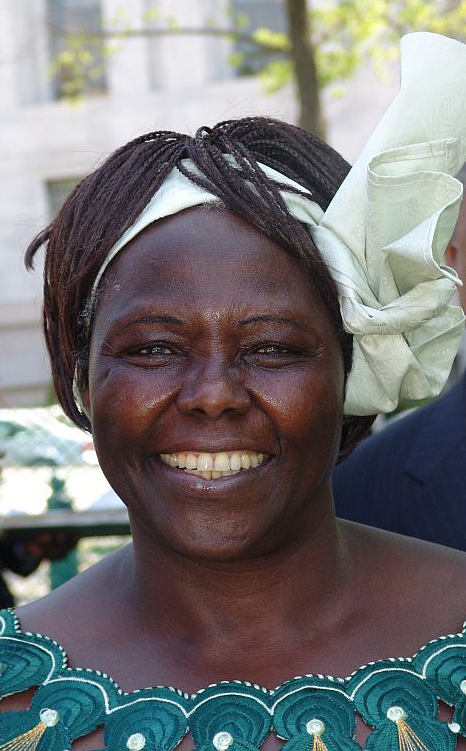
When the Norwegian Nobel Committee announced in 2004 that the Peace Prize would go to a Kenyan woman who had spent nearly three decades persuading villagers to plant trees, some observers were puzzled. What did planting trees have to do with peace? Wangari Maathai had spent her life answering exactly that question. She understood, long before it became conventional wisdom, that the degradation of the environment, the abuse of political power, and the oppression of the poor were bound together, and that you could not solve one without confronting the others. From a rural village in the highlands of central Kenya she rose to become the first African woman and the first environmentalist to win the Nobel Peace Prize, and a global symbol of the link between ecology, democracy and human dignity. Her story is one of courage exercised quietly, one seedling and one act of defiance at a time.
Quick Facts
- Full name
- Wangari Muta Maathai
- Born
- 1 April 1940, Nyeri, Kenya
- Died
- 25 September 2011, Nairobi, Kenya (aged 71)
- Known for
- Founder of the Green Belt Movement; environmental and political activist
- Nobel Prize
- Peace, 2004 (first African woman to win)
Early Life and Background
Wangari Muta was born on 1 April 1940 in a rural village in the Nyeri district, in the fertile highlands of central Kenya. Her family were Kikuyu farmers, and she grew up close to the land, in a world where the streams ran clean and the forests were thick and the rhythms of planting and harvest governed daily life. That early intimacy with a healthy natural environment gave her a standard against which she would later measure the damage that deforestation and careless development inflicted on her country.
Kenya was then a British colony, and education for African girls was rare. But Wangari’s family made the decision to send her to school, and she proved a gifted student. She attended a Catholic mission school and then a respected girls’ high school in Limuru, excelling academically at a time when few women in East Africa had the opportunity. Her intelligence and determination set her apart, and they opened a door that would change the course of her life.
Growing Up in a Changing Kenya
The Kenya of Maathai’s childhood was a land in transition and under strain. British colonial rule had displaced many Kikuyu families from their ancestral lands, and the resentment this caused would eventually erupt into the Mau Mau uprising of the 1950s, a violent struggle for land and freedom that unfolded during her school years. She grew up acutely aware of the injustices of the colonial system, of the way the most fertile land had been taken for settler farms, and of the dignity and resilience of ordinary rural Kenyans who endured these hardships.
Her mother was a powerful early influence, a woman of quiet strength who instilled in her a respect for the natural world. Maathai often recalled being told as a child not to disturb certain trees and streams that were regarded as sacred, lessons in conservation passed down through tradition long before the language of environmentalism existed. These early experiences planted the seeds of a worldview in which the land was not merely a resource to be exploited but a living inheritance to be cared for and passed on. When she later watched that same land being stripped of its forests and its soil washed away, she felt the loss not only as an ecological disaster but as a betrayal of something sacred.
Education in America and Beyond
In 1960, as the era of African independence dawned, Wangari was among hundreds of promising East African students selected for a programme that became known as the “Kennedy Airlift,” which brought them to study at universities in the United States. It was a transformative opportunity. She studied biology at Mount St Scholastica College in Kansas, earning her degree, and then completed a master’s degree at the University of Pittsburgh. The years in America exposed her to new ideas about democracy, civic responsibility and the environment, and to a culture of activism that would later inform her own.
Returning to a newly independent Kenya, she continued her studies and her scientific career, and in 1971 she earned a doctorate from the University of Nairobi, becoming the first woman in East and Central Africa to obtain a PhD. She went on to become the first woman to head a department at the University of Nairobi, chairing the department of veterinary anatomy, and the first woman in the region to attain the rank of associate professor. Each of these milestones was a quiet act of pioneering in a society where leadership roles were almost entirely closed to women.
“It’s the little things citizens do. That’s what will make the difference. My little thing is planting trees.”
The Green Belt Movement
For all her academic success, Maathai was increasingly drawn to the problems she saw in the rural communities of Kenya, especially among women. The forests were being cut down, the soil was eroding, streams were drying up, and rural women had to walk further and further to find firewood and clean water. Maathai saw a solution that was at once simple and profound: pay rural women to plant trees.
In 1977 she founded the Green Belt Movement, an organisation that mobilised ordinary women to establish tree nurseries and plant seedlings across the Kenyan countryside. The idea grew far beyond anyone’s expectations. Over the decades the movement planted tens of millions of trees, restoring degraded land, providing firewood and food, and creating income for the women who did the work. But the movement was about more than trees. It gave rural women a sense of agency and dignity, teaching them that they had the power to improve their own communities, and it became a school of grassroots democracy.
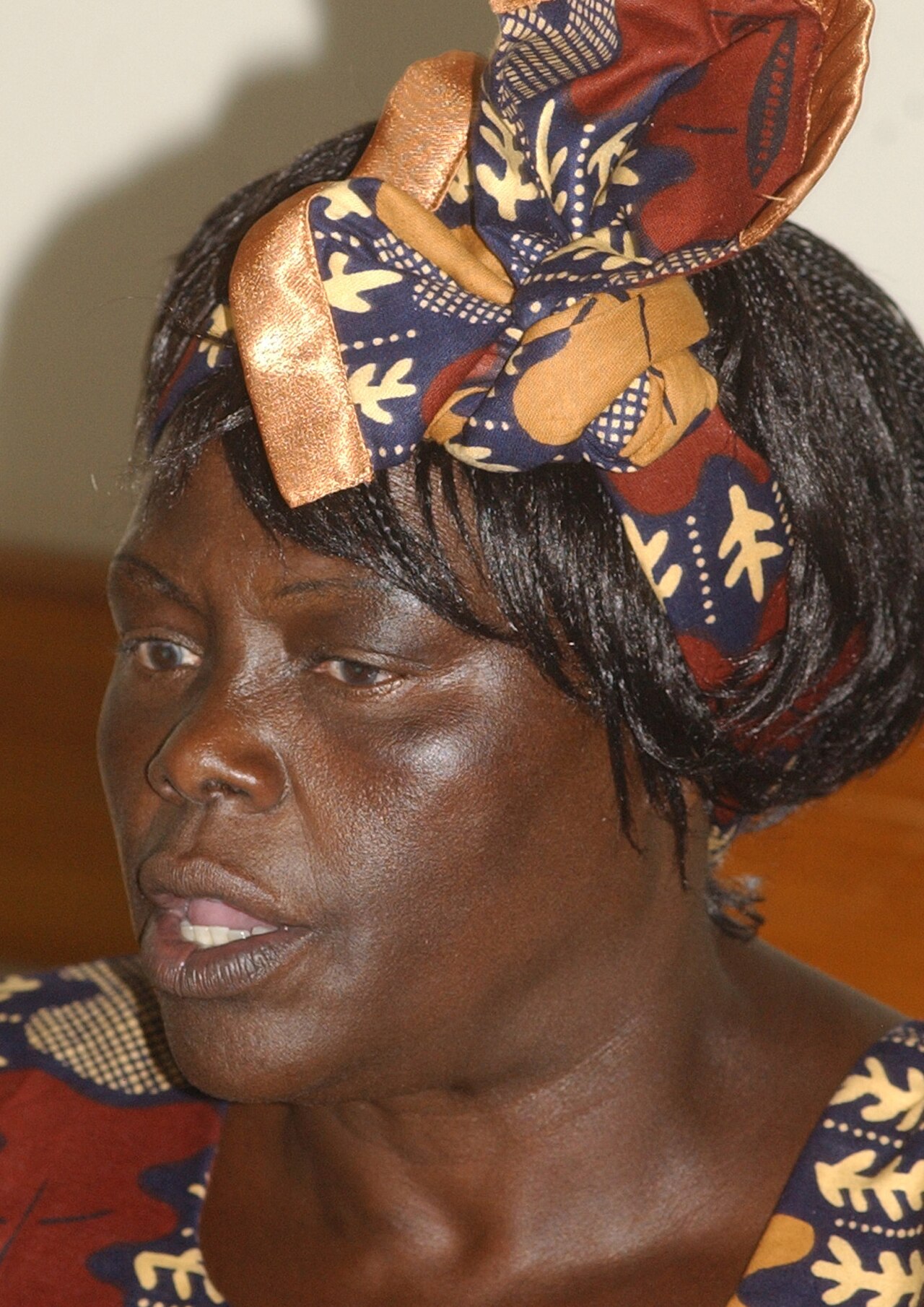
Maathai understood that environmental destruction was not simply a technical problem but a political one, rooted in bad governance, corruption and the exclusion of ordinary people from decisions about their own land. As the Green Belt Movement grew, it inevitably brought her into conflict with powerful interests.
Confronting Power
By the 1980s and 1990s, Maathai had become one of the most prominent critics of the authoritarian government of President Daniel arap Moi. She opposed the regime’s plans to hand public land to political allies and to build on green spaces that belonged to the people. In one famous campaign she fought to stop the construction of an enormous skyscraper and a statue of the president in Uhuru Park, the great public green space in the centre of Nairobi. Her opposition helped scare off the foreign investors, and the park was saved. In another, she led the defence of the Karura Forest on the edge of Nairobi against developers, and was beaten by hired thugs during one of the confrontations.
For her activism she was vilified by the government, placed under surveillance, arrested repeatedly, and imprisoned. She was beaten and tear-gassed. Officials mocked her, questioned her right as a woman to speak out, and tried to portray her as a troublemaker. She endured a difficult divorce in which her outspokenness was used against her. Yet she refused to be silenced. She drew on deep reserves of courage and conviction, often standing alone against the full weight of the state, armed with little more than moral authority and an unshakeable belief in the rightness of her cause.
How the Movement Worked
Part of the genius of the Green Belt Movement lay in its simplicity. Maathai did not arrive in villages with grand theories or expensive technology. She taught women a method they could carry out themselves: collect seeds from existing trees, plant them in nurseries, nurture the seedlings, and transplant them once they were strong enough to survive. The women were paid a small amount for every seedling that took root and lived, which gave them both an income and a direct stake in the success of the project.
This approach achieved several things at once. It restored tree cover to land that had been stripped bare, which slowed soil erosion, protected water sources and provided firewood and fruit. It put modest but meaningful earnings into the hands of rural women who had few other ways to make money. And, perhaps most importantly, it changed how those women saw themselves. Many had been taught to believe that the problems around them were too large to address and that solutions could only come from governments or experts. Maathai showed them that they could act, that their own hands could heal the land, and that this power belonged to them. The act of planting a tree became an act of empowerment and a small lesson in self-government.
Maathai often spoke of the connection between the health of the soil and the health of a society. She argued that a country which allowed its forests to be plundered by a corrupt elite was also a country that abused its people, and that the same culture of impunity lay behind both. This insight, that environmental management and good governance are inseparable, was decades ahead of its time and lay at the heart of everything she did.
The Nobel Peace Prize
In October 2004, the Norwegian Nobel Committee awarded Wangari Maathai the Nobel Peace Prize for her contribution to sustainable development, democracy and peace. She was the first African woman ever to receive it, and the first person to be honoured with the prize primarily for environmental work. The committee recognised what Maathai had argued for decades: that there can be no lasting peace without the responsible management of the environment and the resources on which people depend, and that protecting natural resources, defending democracy and securing the rights of the poor are deeply connected.
The award brought global attention to her message and to the Green Belt Movement, and it elevated environmental protection to the level of a peace and human rights issue in a way it had never been before. Maathai received the honour with characteristic grace, planting a tree on the day of the announcement, a gesture that captured the simplicity and depth of her life’s work.
The Message of the Nobel Lecture
When Maathai delivered her Nobel lecture in Oslo in December 2004, she used the occasion to set out the philosophy that had guided her life. She spoke of the women of rural Kenya who had inspired the Green Belt Movement, and of how the simple act of planting a tree could restore not only the land but also hope and a sense of possibility. She called on people everywhere to recognise that the resources of the Earth are finite and must be shared fairly and managed responsibly, and she insisted that the campaign for a healthy environment was inseparable from the campaigns for democracy, peace and human rights.
She also spoke of the need to heal the wounds of the past and to treat one another, and the planet, with greater care. Her words carried particular weight because they came not from a distant theorist but from a woman who had been beaten and jailed for acting on her beliefs, who had dug her hands into the soil alongside the rural women she championed, and who had faced down a government with nothing but conviction. The lecture became one of the defining statements of the modern environmental movement, articulating a vision in which caring for the Earth and caring for one another are understood as a single moral task.
Throughout her public life, Maathai grounded this vision in a deep spiritual sensibility. She drew on the traditions of her Kikuyu upbringing, which had taught her to regard nature as sacred, and combined them with her Christian faith and her scientific training. The result was a worldview that refused to separate the practical from the moral, the ecological from the political, or the local from the global. A degraded hillside in central Kenya and the fate of the planet were, in her eyes, part of the same story.
Politics and Later Life
Maathai’s struggle was not confined to forests and parks. With the return of multi-party democracy to Kenya, she entered electoral politics, winning a seat in parliament in 2002 with an overwhelming majority and serving as an assistant minister for environment and natural resources. She continued to campaign internationally, founding initiatives to spread the tree-planting model across Africa and beyond, writing books including her memoir Unbowed, and speaking around the world on the environment, governance and the empowerment of women.
She often told the story of the hummingbird, which carries one drop of water at a time to fight a forest fire while the larger animals stand by helplessly. She used it to illustrate her philosophy that each person, however small their contribution may seem, has a responsibility to do what they can. It was the principle that had guided her from the very first seedling planted by the Green Belt Movement.
A Writer and a Global Voice
As her fame spread, Maathai used her platform to reach audiences far beyond Kenya. She wrote several books that explained her philosophy and told her story, including her memoir Unbowed, which recounted her journey from a rural village to the world stage with honesty and warmth. In other works she set out her ideas about Africa’s challenges and the moral and spiritual dimensions of caring for the Earth, arguing that environmental stewardship was a duty shared by every human being.
She helped extend the tree-planting model across the African continent and inspired international campaigns, including a global effort to plant a billion trees that grew into a movement of its own. She served on international commissions and advisory boards, lectured at universities around the world, and met with heads of state and ordinary citizens alike, always returning to the same message: that ordinary people, acting together, hold the power to repair their world.
Personal Life
Maathai’s personal life was marked by the same pressures that her public defiance invited. Her marriage ended in a bitter and very public divorce, during which her husband reportedly claimed she was too strong-willed and too educated for a woman, a charge that said more about the society of the time than about her. She was briefly jailed after making comments about the divorce judge. Through these trials she raised three children and remained devoted to them, even as her activism consumed her time and exposed her to danger. She drew strength from her faith and from her deep sense of purpose, and she refused to let personal hardship deflect her from the work she believed she was called to do.
Legacy and Death
Wangari Maathai died of cancer on 25 September 2011 in Nairobi, at the age of seventy-one. In keeping with the values she had championed all her life, she had asked not to be buried in a wooden coffin, so that no tree would be cut down on her account, and a casket made of locally sourced materials such as bamboo and papyrus was used instead. Her death was mourned across Kenya and around the world, and she was honoured as a national hero and a global icon. The Green Belt Movement she founded continues its work, and the trees she inspired millions of people to plant still stand as a living monument to her vision.
Her legacy extends far beyond the forests of Kenya. She changed the way the world thinks about the environment, insisting that it is a matter of justice, democracy and peace rather than a narrow technical concern. She showed that grassroots action by ordinary people, especially women, can challenge entrenched power and reshape a nation. And she demonstrated, through a lifetime of quiet courage, that one determined person armed with conviction and a handful of seeds can make a difference that echoes across continents and generations.
For the people of Africa in particular, Maathai stands as a powerful example of homegrown leadership and self-reliance. She did not wait for solutions to arrive from abroad or for permission from those in power. She looked at the problems in front of her, identified what she and her neighbours could do with their own hands, and set to work. In a world that often tells the poor and the marginalised that they are helpless, her life is a standing rebuttal. The tens of millions of trees that now grow across the Kenyan landscape are her monument, but her deeper legacy lies in the idea she planted in the minds of all who heard her: that the future is not something that happens to us, but something we create, one small and stubborn act of hope at a time.
Key Facts
- Wangari Maathai was the first woman in East and Central Africa to earn a doctorate, awarded by the University of Nairobi in 1971.
- In 1977 she founded the Green Belt Movement, which has planted tens of millions of trees across Kenya and empowered rural women.
- She was repeatedly arrested, beaten and imprisoned for opposing the authoritarian government of President Daniel arap Moi and defending public land such as Nairobi’s Uhuru Park and Karura Forest.
- In 2004 she became the first African woman and the first environmentalist to win the Nobel Peace Prize.
- She served in the Kenyan parliament from 2002 and remained a global advocate for the environment, democracy and women’s rights until her death in 2011.