In the late spring of 1940, Britain was losing a war. The Wehrmacht had swept through the Low Countries and France with a speed and violence that shattered the assumptions of the Allied high command. More than 330,000 British and Allied soldiers had been rescued from the beaches of Dunkirk in a desperate improvised evacuation, but they had left behind their heavy equipment, their vehicles, and any immediate prospect of fighting back. France was about to fall. The United States had not yet entered the war. The Soviet Union was still operating under the terms of a non-aggression pact with Nazi Germany. Britain stood essentially alone, and a significant faction of the War Cabinet, led by the Foreign Secretary Lord Halifax, was quietly exploring whether a negotiated peace with Hitler was the least catastrophic available option.
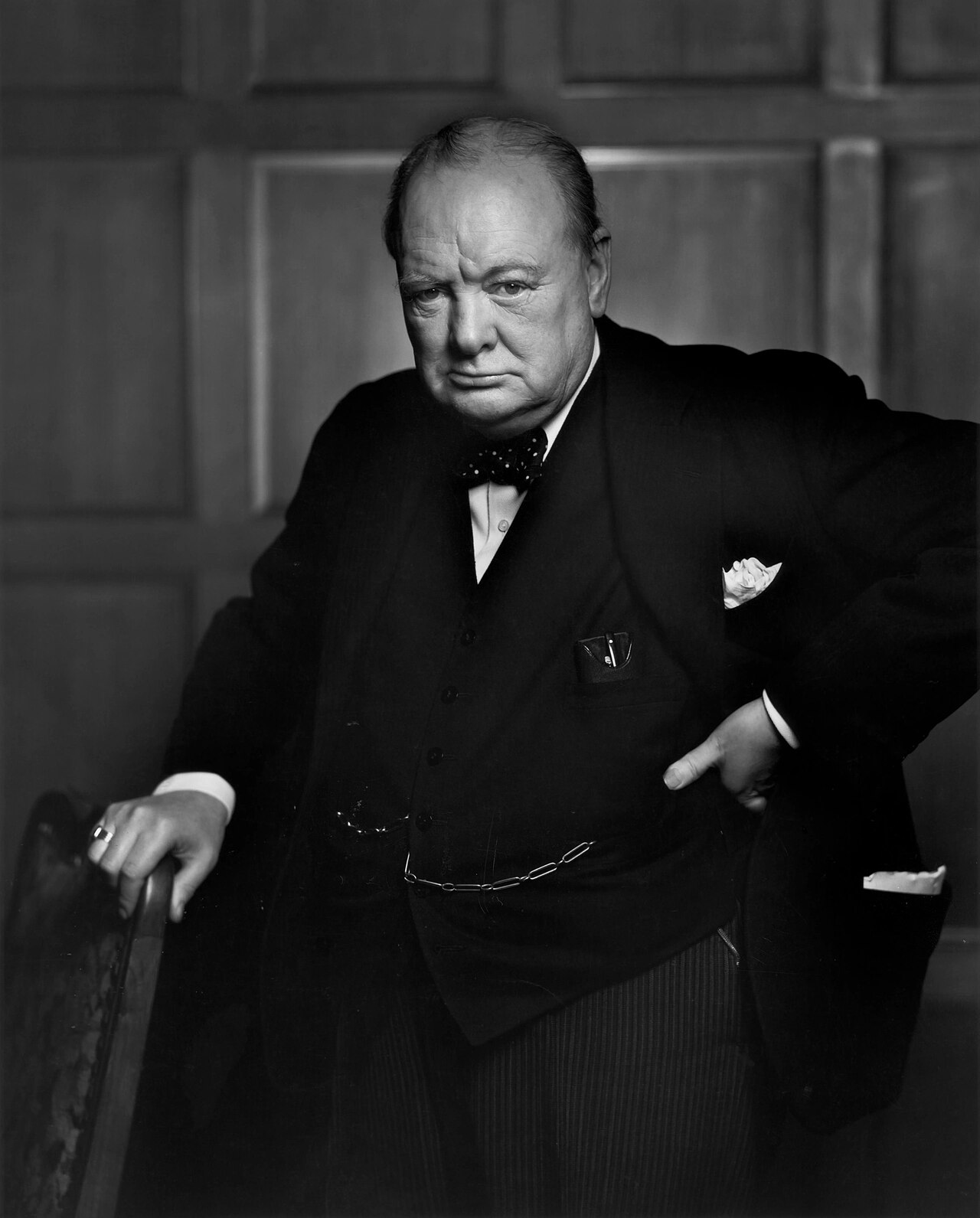
Into this crisis had stepped, just weeks earlier, a sixty-five-year-old man who had spent much of the previous decade in political exile, widely regarded as a dangerous romantic, an impulsive adventurer, a man whose judgment had already once helped produce a military catastrophe. Winston Spencer Churchill had been First Lord of the Admiralty on a previous occasion and the Gallipoli campaign of 1915 had effectively ended his career for a generation. He had held office under four monarchs and served in six wars. He had been a war correspondent, a cavalry officer, a prisoner of war who escaped, a minister, a chancellor, a newspaper columnist, a historian, and a painter. He had been right about many things and wrong about many others, sometimes spectacularly. And now, at an age when most politicians have long since retired, he was Prime Minister of the United Kingdom, confronting the greatest threat to British civilisation in four centuries.
Quick Facts
- Full name
- Winston Leonard Spencer-Churchill
- Born
- 30 November 1874, Blenheim Palace, Oxfordshire, England
- Died
- 24 January 1965, London, England (aged 90)
- Known for
- Prime Minister of the United Kingdom (1940 to 1945 and 1951 to 1955); leadership of Britain during the Second World War
- Notable achievement
- Nobel Prize in Literature, 1953; honorary citizen of the United States, 1963
Blenheim and a Gilded, Lonely Childhood
Winston Churchill was born on 30 November 1874 at Blenheim Palace, the ancestral seat of the Dukes of Marlborough, in a room that was hurriedly converted into a birthing chamber because his mother had gone into premature labour during a party. The palace, a vast baroque monument built by Parliament to reward the first Duke of Marlborough for his victory at the Battle of Blenheim in 1704, established from the beginning the scale on which Churchill measured things: grand, historical, weighted with the obligation to live up to famous ancestors.
His father, Lord Randolph Churchill, was one of the most brilliant and erratic politicians of the Victorian age. A Conservative MP and Chancellor of the Exchequer, Randolph had real gifts and a genius for self-destruction. He resigned from the Cabinet in 1886 in a miscalculation that effectively ended his career, and he died in 1895, probably from syphilis, at the age of forty-five. Winston idolised him from a distance, because distance was what the father maintained. Lord Randolph found his son disappointing, too slow, too ungovernable at school, not promising enough to merit sustained attention. The wound of that paternal coldness never fully healed; Churchill spent much of his career unconsciously answering a man who had died before he could be answered.
His mother, Jennie Jerome, was the daughter of Leonard Jerome, a wealthy American financier from New York. Beautiful, vivacious, and socially commanding, Jennie was by all accounts a spectacular figure in London society and a frankly indifferent mother. Churchill recalled that she shone for him like the evening star, always there, always remote. His affective needs were met by his nanny, Mrs. Everest, whose death in 1895 was genuinely one of the hardest losses of his life. He kept her photograph by his bedside until his own death.
At Harrow, one of England’s great public schools, Churchill was a mediocre student in most subjects and an outstanding one in English composition. He memorised long passages of poetry and prose and could recite them decades later. He struggled with mathematics and Latin. He was an undisciplined but genuinely gifted writer from his earliest years.
The Soldier and the Correspondent
Having failed the entrance examination to the Royal Military College at Sandhurst twice, Churchill passed on his third attempt and was commissioned into the 4th Queen’s Own Hussars in 1895, the same year his father died. He was immediately drawn not just to military service but to the proximity of danger and the opportunity to write about it. He arranged to be attached to Spanish forces fighting insurgents in Cuba in 1895, earning his first journalism credit and, he claimed, developing his lifelong habit of taking an afternoon nap.
In India, posted to Bangalore with his regiment from 1896 to 1899, Churchill engaged in an extraordinary programme of self-education. Aware of the gaps in the formal schooling he had received, he wrote to his mother asking her to send him books: Gibbon’s “Decline and Fall of the Roman Empire,” Macaulay’s “History of England,” Plato’s dialogues, Aristotle’s “Politics,” the complete works of Schopenhauer. He read for several hours every afternoon, the same hours that his more conventionally educated officers were sleeping, and absorbed a version of a classical education that was all the more thoroughly his own for being self-administered.
He saw action on the North-West Frontier in 1897, participated in the charge of the 21st Lancers at the Battle of Omdurman in Sudan in 1898 (one of the last great cavalry charges in British military history), and covered the Boer War in South Africa as a correspondent for the Morning Post in 1899. Captured by the Boers in an ambush, he escaped from a prisoner-of-war camp in Pretoria by climbing over a wall and hiding in a mine shaft for days before being smuggled out of the country by sympathetic British colonists. The escape made him famous across the British Empire and effectively launched his political career.
Parliament, Office, and the First Career
Churchill was elected to Parliament as a Conservative MP for Oldham in 1900, shortly after his return from South Africa. Within four years he had crossed the floor of the House to join the Liberal Party, primarily over the issue of free trade (he opposed protectionist tariffs that the Conservative government was considering). It was a move that earned him lasting enmity among Conservatives and would complicate his political life for decades.
Under the Liberal governments of 1905 to 1915, he rose with startling speed. As President of the Board of Trade from 1908 to 1910, he worked alongside David Lloyd George to introduce labour exchanges and the first elements of a national insurance scheme, laying foundations of the British welfare state. As Home Secretary from 1910 to 1911, he made decisions that were sometimes controversial: his presence at the Siege of Sidney Street in London, where anarchists were surrounded by police and eventually burned alive when the building caught fire, was widely mocked as an example of his attraction to military adventure in civilian contexts.
As First Lord of the Admiralty from 1911, he oversaw the naval modernisation programme that had the Royal Navy prepared for war when hostilities began in August 1914. He was an energetic and often brilliant administrator, but his energy was also his danger: he was attracted to bold, unconventional ideas that did not always survive contact with operational reality.
Gallipoli and the Wilderness Years
The Gallipoli campaign of 1915 was Churchill’s first great political catastrophe. The idea of forcing the Dardanelles strait with a naval assault, bypassing the Western Front’s grinding stalemate, was not wholly without strategic merit. But it was Churchill’s idea, championed against military scepticism, and when the naval assault failed and the subsequent land campaign became a bloodbath that cost more than 250,000 Allied casualties, Churchill became the face of the disaster. He was demoted from the Admiralty, resigned from the government, and commissioned as a battalion commander on the Western Front, leading troops from a front-line headquarters in a farmhouse.
He returned to government in 1917 as Minister of Munitions under Lloyd George, and rose further under subsequent governments. But his career never quite regained the trajectory of his pre-Gallipoli years. His decision as Chancellor of the Exchequer in 1925 to return Britain to the gold standard at pre-war parity was an economic mistake that deflated wages and contributed to the General Strike of 1926. His vocal opposition to Indian self-government in the early 1930s placed him well outside the liberal consensus on Empire. His support for King Edward VIII during the abdication crisis of 1936, against the wishes of virtually everyone in British political life, further isolated him.
By the mid-1930s, Churchill was in what he called his “wilderness years,” a period when he held no government office and was widely regarded as a spent force. He occupied himself at his country house, Chartwell in Kent, by writing, painting, building walls, and pursuing his prodigious journalism. He was deeply in debt. He drank heavily (though the legends about his consumption have been considerably exaggerated). He suffered periodic episodes of severe depression, which he called his “black dog.”
And through all of it, from the moment Hitler became Chancellor of Germany in January 1933, he warned, clearly and repeatedly and with extraordinary accuracy, about the nature of the Nazi threat, the inadequacy of British rearmament, and the danger of appeasing a regime that had made clear its territorial ambitions and its contempt for treaty obligations. He was ignored, mocked, and dismissed. The policy of appeasement culminated in the Munich Agreement of September 1938, when Neville Chamberlain returned from Germany claiming to have secured peace in their time.
Churchill called Munich “a total and unmitigated defeat.”
He was right.
Prime Minister: The Finest Hour
Germany invaded Poland on 1 September 1939. Britain declared war two days later. Churchill was immediately brought back into the government as First Lord of the Admiralty, the same position he had held at the start of the previous war. On 10 May 1940, the same day Germany launched its invasion of France and the Low Countries, Neville Chamberlain resigned as Prime Minister. Churchill was the only candidate with the authority to lead a national government.
What he did in the following weeks, when the situation was objectively catastrophic, constitutes one of the most remarkable exercises of political will in the history of leadership. He did not have popular support in the conventional sense: the British public had had little reason to trust him. He did not have his Cabinet’s full support: Halifax and others believed negotiation with Hitler was necessary and perhaps inevitable. He did not have military resources adequate to the threat: the British Army had evacuated from Dunkirk and the Royal Air Force was stretched thin.
What he had was language. His speeches in May and June of 1940, delivered in Parliament and broadcast on the radio, were not rhetorical tricks or propaganda formulas. They were arguments, made in public, for a particular assessment of reality and a particular set of conclusions about what was required in response to that reality. He told the House of Commons that he had nothing to offer but blood, toil, tears and sweat. He described Dunkirk not as a defeat but as evidence of a spirit that would not yield, while being scrupulously honest that wars were not won by evacuations. He said that Britain would fight on the beaches, in the fields and streets and hills, that it would never surrender.
We shall fight on the beaches, we shall fight on the landing grounds, we shall fight in the fields and in the streets, we shall fight in the hills; we shall never surrender.
These words, delivered on 4 June 1940, worked not because they promised victory but because they refused the alternative. In a moment when the rational case for surrender was genuinely compelling, Churchill made it psychologically and morally impossible by articulating what surrender would mean. The British people, who were by this point listening very carefully, concluded that they agreed with him.
The War Years: Strategy, Alliance and Controversy
As war leader, Churchill was tireless, demanding, sometimes brilliantly right and sometimes dangerously wrong. He maintained a working schedule that would have exhausted men half his age, conducting much of his business from bed in the mornings, sleeping briefly in the afternoons, and working late into the night. He was personally brave in ways that alarmed his security detail, visiting bombed-out areas of London, travelling to combat zones, and insisting on watching the D-Day landings from a naval vessel until King George VI threatened to go himself if Churchill did.
His management of the alliance with the United States was a central strategic achievement. He had cultivated Franklin Roosevelt before the war, and the two men developed a genuine and productive friendship, conducted partly through an extraordinary correspondence that ran to thousands of messages. Churchill understood, from the start, that American entry into the war was the prerequisite for Allied victory. The Lend-Lease arrangement of 1941, under which the US supplied war material to Britain on deferred payment, was a critical early step. Pearl Harbor and Germany’s declaration of war against the United States in December 1941 completed the coalition.
Managing the three-way relationship between Britain, the United States and the Soviet Union was harder. At the Tehran Conference in 1943 and the Yalta Conference in 1945, Churchill found himself increasingly the junior partner as Roosevelt and Stalin negotiated the post-war order. His attempt to preserve British influence in Eastern Europe through the “percentages agreement” with Stalin in October 1944 (a piece of paper on which he wrote proposed spheres of influence for Romania, Greece, Yugoslavia, Hungary and Bulgaria) was a characteristic piece of realpolitik that has been criticised ever since as a cynical bargain in human freedom.
His war leadership also produced decisions that remain deeply troubling. The area bombing campaign against German cities, which Churchill approved and which was carried out by RAF Bomber Command under Arthur Harris, killed an estimated 300,000 to 600,000 German civilians. Churchill’s actions during the Bengal famine of 1943, in which an estimated 2 to 3 million people died, are a subject of sustained historical debate: his government’s decisions about food distribution, export policy and the prioritisation of war needs over famine relief have been cited as evidence of callous disregard for Indian lives.
Defeat, Return and the Post-War World
Churchill was voted out of office by the British electorate in July 1945, before the war against Japan had even ended. The Labour Party, led by Clement Attlee, won a landslide majority on a programme of social reform and the construction of a welfare state. Churchill was genuinely shocked by the result. The people he had led through the war had decided, quite rationally, that the qualities required to win a war were not the qualities required to build a peace, and that the post-war order they wanted was not the one Churchill would construct.
He led the Conservative Party in opposition and continued to shape world events through his speeches. In March 1946 he delivered the “Iron Curtain” speech at Westminster College in Fulton, Missouri, coining a phrase that would define the Cold War era and calling for an Anglo-American alliance against Soviet expansionism. In 1946 he also called for European integration, though his vision was of a united Europe that Britain would help build but stand slightly apart from, a distinction that would have profound consequences for British politics in the following decades.
He returned to office as Prime Minister from 1951 to 1955, but the second premiership was pale compared to the first. He suffered a serious stroke in 1953 that was concealed from the public. He was awarded the Nobel Prize in Literature that year, for his multi-volume “History of the English-Speaking Peoples” and other historical writings. He finally resigned in April 1955 at the age of eighty, after months of pressure from colleagues who could see that his powers were fading.
The Last Years and Legacy
Churchill lived until January 1965, spending his final years at Chartwell, in his London home at 28 Hyde Park Gate, and on holidays in the South of France and aboard the yacht of his friend Aristotle Onassis. He suffered additional strokes and withdrew progressively from public life. Parliament observed a prolonged period of tribute when he died on 24 January 1965, and his state funeral, the largest in British history to that point, drew heads of government from around the world.
His legacy is a genuinely complex one, more complex than the simplified version that most countries, particularly Britain, find comfortable. He was undeniably the right person for the specific crisis of 1940: his stubbornness, his verbal genius, his refusal to accept defeat, his ability to project absolute conviction in a situation where absolute conviction was desperately required, these qualities were precisely what was needed. The survival of British democracy in 1940, and by extension the survival of a western Europe that was not under Nazi domination, owes more to his will than to any other individual factor.
He was also a man of the Victorian Empire who never fully made peace with the fact that the empire was ending, who held views on race and colonial subject peoples that were within the mainstream of his class and era but are indefensible by any subsequent moral standard, and who made decisions during the Bengal famine that resulted in mass death. He was both these things simultaneously, and the difficulty of holding that complexity is why the arguments about him have not ended and will not end.
What he gave Britain in 1940 is permanent, whatever else he was. When France had fallen and the United States was still neutral and the Soviet Union was allied with Germany and the only rational calculation pointed toward negotiating the best available terms, Churchill made the irrational, history-changing choice to fight on. And he persuaded an entire nation to make the same choice.
Key Facts
- Churchill was born at Blenheim Palace on 30 November 1874 and entered politics at the age of twenty-five after a career as a soldier and war correspondent.
- He served as a front-line battalion commander on the Western Front in 1915 to 1916 after his political demotion following the Gallipoli disaster.
- His broadcasts and parliamentary speeches in May and June 1940, particularly the “We shall never surrender” address, are considered the most consequential acts of oratory in British history.
- He won the Nobel Prize in Literature in 1953, primarily for his six-volume “The Second World War” and other historical writings.
- He lived to ninety years of age and received a state funeral attended by representatives of one hundred eleven nations, one of the largest ceremonial gatherings in post-war history.